10 Reasons The Quiet Place Is the Ideal Getaway

I’m here today to let you in on a little secret. Perhaps it’s a poorly kept secret, as I keep discovering more people amidst my own network who are familiar with this Upstate New York gem — but, even then, it feels like we’re part of a really cool club. And I want more of you to get to experience it.

The Quiet Place Getaways are a group of properties nestled in prime locations throughout the Finger Lakes region. As the name promises, the focus is on quiet — you’ll have plenty of space to yourself and feel encouraged to slow down and appreciate your surroundings.

The accommodations range in size to suit anywhere from 2-6 people. Solo retreats are also an option (mostly at the 2-person properties; occasionally at a larger one, depending on availability). I highly recommend this for writers and any other creative types. It’s immensely productive!

The business of bookings and communications is centrally managed by a lovely husband-and-wife team, but each property is individually owned. They’re like a family, each member with its own unique personality and strengths. I don’t know if there’s a certain checklist to be included in the group, but there’s clearly a certain standard to be maintained, a particular vibe shared amongst them so that, browsing the properties, you quickly get a sense of the brand. Not just any place would make the cut.

I’ve been blessed to stay at several of these properties in recent years, and maybe I’ll write about the others another time, but first and foremost I need to tell you about the Naples Chalet, my favorite of the bunch. (Sorry, others; you’re great too!) This place played a critical role in the drafting and revising of my first book, provided a safe getaway during the height of the COVID-19 pandemic, and unexpectedly became a place for healing when I sprained my foot the night before one of my stays.

Coming here feels like nestling into my own little oasis. I walk up the gravel path, an expansive view rolling forth as I round the corner, where I always need to pause to breathe deeply and take it in. Standing here, I feel very small in the most moving way — there is so much to see and smell and hear, the open air stretched out endlessly before me, just from this one little spot. (That’s Canandaigua Lake visible just over the treetops.)

This view, walking up to the Naples Chalet, gets me every time.

Throughout my stay, I feel assured that every need has been thoughtfully addressed — and yet I’m left entirely to my own devices, in the best sense of the phrase. (And the best of both worlds for an introvert like me!) I don’t have to talk to anyone upon checking in, stand in a crowded elevator with chlorine-scented children dripping from a pool, or worry about neighbors having their TV on too loud or slamming their doors in the middle of the night.

While details vary across the properties, the general vibe and the goals are the same, with a focus on relaxing and recharging.

So, with some details here specific to my beloved Naples Chalet, here are 10 reasons why you should consider The Quiet Place for your ideal getaway.

1. It’s QUIET! You’re unlikely to cross paths with any other people while at your stay. If there are other houses anywhere in the vicinity, there’s some sort of unspoken understanding that this is a place for peace, calming, and reflection.

2. At the same time, it’s close to great food, wineries, trails, shops, and more. Naples, Canandaigua, and Bristol are a short drive, so if you want to be among people and find things to do, you’ll have plenty of options.

3. Beautiful views, surrounded by nature, are a standard accommodation. Every property has some combination of deck, porch, sunroom, and/or fire pit, to encourage you to soak up your surroundings.

4. Most properties have a hot tub and/or a soaking tub inside, for an added element of melting away your stress.

5. It’s well stocked with amenities — you’re away from it all but by no means roughing it. You’ll have that “off the grid” feeling while still having electricity, plumbing, heat / AC, and Wi-Fi!

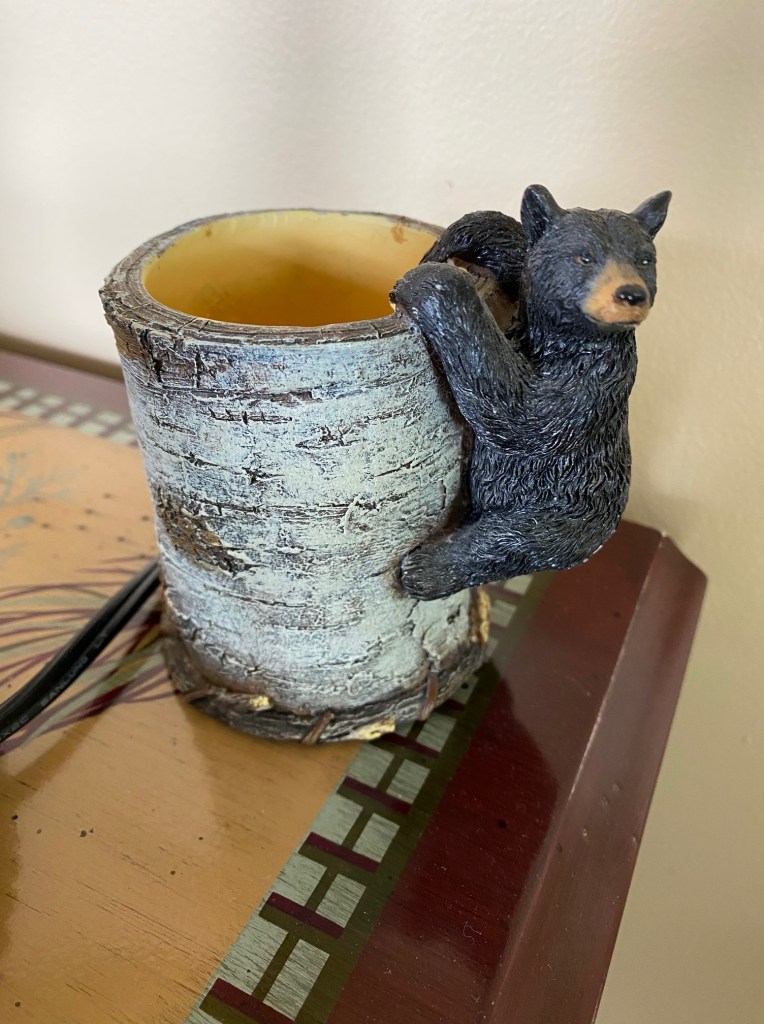
6. The décor is gorgeous and creative, with so many fun little gems to discover. I love walking slowly around the Naples Chalet to see what touches have been added since my last stay. It demonstrates how much the owners care for their properties.
7. Likewise, there are always thoughtful hostess touches. When I step inside the Naples Chalet, I’m greeted by piano music playing softly from the stereo across the room, like I’ve just walked into a spa. Flowers and Hershey kisses grace the table. There are welcoming details at every turn: flyers and coupons for local restaurants and wineries, bottled water, and more fresh flowers in the bathroom and on the deck.

8. It’s the ideal atmosphere whether for a solo retreat (for me, focused writing and marketing time), a couple’s getaway, or catching up with friends. Slowing down and simplifying is a natural catalyst for reconnecting.

My workstation while at the Naples Chalet. I feel like I’m in a treehouse.

9. You’re working with a small group of local people for booking and during your stay, providing great communication and helpful guidance. They can talk you through which property is best for you or what to do while you’re in the area.

10. For all of this, the price is the same as (or less than!) what you’d pay for a nice hotel room — and you’re getting an entire experience.

All of this adds up to a justified investment in myself — my work, my mental health, my overall wellbeing.

I always leave a Naples Chalet stay wishing it could have lasted a bit longer and hoping I can carry home with me the sense of renewal and restoration it’s granted me. As I walk back along the gravel path, I again pause by the Adirondack chairs to take in that view one more time, breathe deeply, and meditate a moment on a flooding warmth of gratitude.

A Blog for the Turn of the Year

We’re officially 1/52 of the way through 2023.

Did you feel shocked (like I did) when trying to process that statement? And also a little anxious about how fleeting time is? And yet also, maybe, a little relieved in knowing we’ve already made it through a week of this rocky adjustment?

The start of this year has felt rough. These past couple weeks, as 2022 wrapped up and as the new year began, I’ve had a striking number of conversations about mental health with people who are struggling. And I count myself among that lot.

It doesn’t help that it’s been cold and rainy — and at times snowy and icy, or that many of us settled in to enjoy a major Monday Night Football match-up only to watch in horror as Damar Hamlin collapsed, or that that hardship hit Buffalo (a neighboring city here, home to many loved ones) right on the heels of its devastating blizzard, or that this is the fourth calendar year in which the COVID-19 pandemic looms over our lives…

Many of us are feeling shaken, discouraged, and simply exhausted. We want to start this new year with hope and resilience but are reminded of our own mortality and how quickly life can change.

Beyond those recent and (hopefully) unusual factors, the holiday season can often stir up grief and longing. I love Christmas, easily caught up in the giddiness and magic like a child would be, and yet it makes me miss my beloved fur baby so badly that hanging up her stocking still brings tears to my eyes, 3 years after her death, and the pangs of nostalgia I feel for childhood Christmases can sting, wishing that somehow, just for a few minutes, I could be back at the top of the stairs with my brothers, waiting for our parents to be settled with their coffee and video camera, ready for us to come down and see what wonders await.

Just as the complicated mix of merriment and sadness of the Christmas season winds down, here comes the new year — a time when we put extra pressure on ourselves to feel festive, to reflect on accomplishments, to set goals, to do better. It can be exhausting!

Several years ago, I received as a gift the book Tape for the Turn of the Year, by A.R. Ammons. It’s a long, journal-like poem that he typed on a roll of adding-machine tape, written between December 1963 and January 1964. I was enthralled by the concept, Ammons challenging himself (a) to fill the roll and (b) to be forced to wrap up the piece within the confines of its medium. Returning to the page (as it were) routinely over the course of those days gives Ammons’s writing a meditative quality, finding beauty and room for contemplation in ordinary moments of ordinary days — which seems to me a beautiful way to think about time.

…all day
life itself is bending,
weaving, changing,
adapting, failing,
  succeeding

A.R. Ammons, Tape for the Turn of the Year

Ever since first hearing the book’s title, I’ve found a sort of comfort in thinking of the arrival of the new year this way, a turn. It’s not merely a beginning (and an ending) but a continuation, a wheel that will keep carrying us along.

Sometimes, making the turn is hard. Sometimes, we long for stability and familiarity, and sometimes that means acknowledging that what was once familiar is now gone, or that we’re not entirely comfortable in our current circumstances.

And that’s okay. This is but a moment of our journey.

If you are struggling:

  • please be patient and gentle with yourself. Allow yourself to feel your feelings and work through them with time.
  • remind yourself that this is a temporary state — one of my favorite mantras I’ve learned from my counselor.
  • know that you are not alone and do not need to navigate the tough times alone. Reach out to a loved one — to me! — or to a counselor or doctor or online community.

If you should choose to make any resolutions for the year, I hope they’ll be ones that truly feel good to you — things you want to do, not things you feel you should do or have to do. In my mind, the shoulds and have tos are immediately laced with anxiety and negative self-talk. (Why haven’t I done that yet? Will I really do it this time?) No one needs that sort of energy to start off the year. Or ever!

Among my resolutions this year is to dedicate more time to self-care. A friend recently told me she takes a self-care day at least once a month, and THAT is the energy I need for 2023! Self-care too often gets bumped to the bottom of the list — which leaves us less equipped to tackle everything else on that list.

Wherever this new year finds you, and wherever it may lead you, I hope you can find ways, old or new, to help yourself feel rested, refreshed, and renewed. To let go of things that no longer serve you and find more things that do.

May your 2023 be whatever you need it to be.

Muse, I’ve done the best
I could:
    sometimes you ran out
    on me
    & sometimes I ran out
    on you:
 
        I know you better now:
        you’ve come closer:
            will you
            confer the high
grace of your touch?
come & live enduring with
me:
            I’ll be faithful:
            I won’t trick you:
            I’ll give you all
            I’ve got:

A.R. Ammons, Tape for the Turn of the Year
Photo by Sumit Rai, downloaded from Pexels

A Dream in Which I Tell Myself “I Would Do Anything for You”

I keep thinking about a dream I had several months ago. It was brief and blurry, but one element has remained persistently clear: I was sitting across from myself [a clone? A reflection? That part I’m not sure of, but there were two distinct yet identical presences of me], and the self that I embodied said to the other, reassuringly, matter-of-factly, “I would do anything for you.”

The caring was instinctive, deeply rooted, the way I feel in my waking hours about my boyfriend, my family, and my dearest friends — a level of protectiveness and pride I feel especially about my nieces and nephews: I don’t want anything bad to happen to you. You are strong and beautiful and talented. I believe in you. I’m here for you anytime. I love you beyond words.

Why don’t I treat myself that way?

Well, a couple months ago, several weeks after having had that dream and having it echo in my mind since, my self-care and -compassion were put to the test.

In one simple misstep, I slipped and fell in the yard, landing with one leg curled awkwardly beneath me and my foot bearing the weight of the rest of me collapsing. I’ve replayed that moment countless times since, as if I could retroactively change my footwear or my armload of stuff or whatever it was I stepped on that caused my foot to slip, and each time I’m struck by the notion that I had no idea in that instant how it would ripple out to affect the entire trajectory of my summer and my physical and mental health.

I don’t intend this to be a pity party nor to belabor the details, so I’ll give the abridged version:

  • The sprained foot led to a blood clot in my leg, which has continued to cause periods of swelling and discomfort as well as send my anxiety and depression on a seemingly endless roller coaster.
  • The prescribed blood thinner required me to stop taking another medication that had long been very helpful for me and left me scrambling for an alternative, none of which have proven satisfactory.
  • It was a hot summer to have one leg encased in a boot brace — although that brace has been a godsend in allowing me much better mobility than I had for the first few days, during which I couldn’t put weight on the foot without intolerable pain.
  • This whole experience has been an eye-opener as to how many elements of my typical day are not easily accessible, with any stairs, gravel, or hills leaving me unsteady at best and at times incapable of navigating without help. That is to say it’s opened my eyes to how very much I was taking for granted before.

The dream was not a stretch in that I have long been one to talk to myself — even out loud, even in public — but this too has now been manifesting in new, gentler ways: “We’ve got this,” I’ll say to myself. [We?! As if, again, there are two of us in the conversation!] “Okay, here we go. One step at a time.” I am aware that I am someone in need of caring and more willing to give myself that care than probably ever before. As I step slowly in and out of the shower or turn gingerly to rinse my hair, as I stretch my cramped-up calf muscle, as I climb into bed and appreciate the shedding of a long day, I am carrying myself differently, with more awareness, patience, and forgiveness.

While I wish it hadn’t taken an injury for this slowing-down to happen and I’m eager to start feeling more like myself again, I hope that as I continue to heal I can maintain this new perspective.

And I wish it for all of you, too — without the dramatic catalyst! Let’s adopt an attitude of showing up for ourselves. We need it more than we may realize.

Photo by Hassan OUAJBIR, downloaded from Pexels

We Need to Talk About Mental Health.

I have anxiety and depression.

People are sometimes surprised to hear this about me, because, I’ve been told, I come across as a generally upbeat, optimistic person. I try to see the good in everyone and everything. That is partially genuine and partially an effort to help myself focus on the good. Because I have anxiety and depression.

Sometimes I’m fine. Sometimes I’m pretending.

In our modern era of oversharing — inundated by social media feeds and phone notifications and email lists we keep meaning to unsubscribe from — somehow we still have trouble being open about the topic of mental health. Our own family members, close friends, and daily coworkers often hide the battles pressing against their chests. (I’ve done so in all of those interactions, and I’ve often learned of others’ battles only after knowing them closely for many years.) This is a critical failure. Those relationships could be lifelines — often literally — if given just a glimpse of the truths we refrain from speaking.

There’s a cruel cycle at play here: for many of us, a key reason we don’t tell others about what we’re dealing with is the negative self-talk that is so inherent in these conditions (and thus only makes them more urgent): People will think I’m weak, pitiful, not good enough, not up for X, Y, Z. This is especially true when there’s a power issue involved (eg, My boss won’t trust me with that project / won’t think I deserve that promotion) but can be true of even our closest relationships with people who think the world of us. Our rational selves know that those people would not judge us. But our self-image is often vastly different from what others perceive of us.

And, of course, the longer we suppress those feelings, the worse they can get; the longer we avoid those conversations, the harder they are to have.

The COVID-19 pandemic has undoubtedly amplified these struggles for countless people and brought on new issues for still more. It can be hard to find the light amidst this long stretch of dark days, during which we’re battling loneliness, fear, and the disappointment of postponed or cancelled plans. I suspect these days we’re all some level of anxious, depressed, or both.

So, I want to share a bit about my experiences, in the hope that it might help others, whether you’re struggling, too, or could be in a position to help people around you who are.

My anxiety makes me feel restless, my thoughts obsessive, my brain unable to quiet down. My depression makes me not want to move, or to feel unable to move. These can be in play simultaneously. It most often happens at night, my mind lit up and spinning like a carnival ride at the same time that my body feels weighed down by a concrete blanket. My body aches for sleep, but my mind won’t let it happen, sometimes for hours.

Writing, exercising, cleaning, or some other burst of productivity will sometimes help lift me out of a depressed stretch or quell my anxiety, as will social time with family or friends. Sometimes, those things don’t help, or they make things worse, or I can’t bring myself to try.

Unfortunately, these feelings typically can’t be explained; it’s not as simple as asking “What’s wrong?” and applying X solution. Yes, sometimes there may be a catalyst that brings on an episode or spurs it into overdrive, but ultimately I’m feeling those things simply because I have anxiety and depression. They are chemical processes that flare up and, thankfully, recede. The lack of an explanation can be confusing for those around me — and for me, too! I ask myself, Why do I feel this way? and think, I shouldn’t feel this way, as my mind rattles off the countless great things in my life.

And then I feel even worse: ungrateful, guilty, and like something must really be wrong with me, if I’m unable to snap out of it when I should have no excuse for feeling down. 

Thankfully, this all happens far less often for me in recent years than it did for many years before. There is no question that this is because I’ve put in 8 years of work through counseling (more on that below) and continue to use the tools I gained there. Personally, I’ve chosen not to take medications, as I wanted to focus instead on understanding my processes and triggers and learning how to work through them. But I know many people for whom medications have made all the difference, and choosing to forgo them wasn’t a decision I made lightly. The choice to medicate, and which one(s) to use, is highly individualized and can be a long process.

Some things that have helped me:

  • COUNSELING! Sooo much counseling. Talking to a professional proved to be absolutely essential for me, even on days when I thought I wasn’t up for it; even on days when I thought I had nothing to say. With time, building that trust and opening up in those sessions helped me to offload tension, gain perspective, communicate better, and listen to myself. Just knowing I had that outlet available — that my next appointment was coming up soon, that I could ask that question or share that progress — came to be such a comfort.
  • Learning that self-care is time well invested. It may be some of the best time invested, the most important. “Mental health days” can be hard to give ourselves permission to take — we worry they’ll be a sign of weakness or laziness or will invite suspicion: Is she really sick? But if our mental and emotional health aren’t cared for, our physical health, our work quality, and our relationships all suffer.
  • As I’ve written about before, gratitude has played a huge role in my wellbeing and is something I continue to put into practice. I love Gretchen Rubin’s Happiness Project one-sentence journal for its simple focus on daily small moments of joy. It has helped me find light during darker days and to remember that things always get better. It’s the only journal I’ve stuck with consistently for any significant length of time. I recently completed a full 5-year journal and started my next one!

Some things you can do to help:

  • Be willing to talk about it. And be willing to listen. Make sure your loved ones know that you’re available for these conversations.
  • Understand that trying to “fix” the situation may not be the best approach. Even when meant as reassurance, saying, “Why don’t you just do this?”or minimizing the person’s concerns as “no big deal” can feel dismissive. Just letting them get some words out (much like in a counseling session) can be so helpful. Maybe ask if they’d like advice, or ask how you can be helpful. And just make sure they know they are heard and valued.
  • Equally important is a willingness to respect their space and their process. For me, anxiety and depression sometimes mean I’m not up for talking or being social or that I have trouble following through on plans, despite my best intentions. It’s nothing personal (even though I worry obsessively that others will see it that way). With a little time, I’ll work through it, and all will be well.

Of course, the perspective I share here is just mine, and others’ will differ in many ways. We each walk a unique journey. But I hope we can work on developing a shared understanding that we need each other, can learn from each other, and can all grow from being willing to talk about the things we too often keep hidden.

Photo by Burst, of what is clearly my spirit animal, downloaded from Pexels