Penny in Paris, Grandpa in Grotte

Up until this past December, I had never traveled out of the country other than to various areas of Canada — which, as a Western New Yorker, is nearby enough to hardly feel like a change of territory. 

I’m blessed that my fiancé, Rich, values traveling and that we have the means to do so. Regardless of your travel inclinations or abilities, I hope you can gain some inspiration from what I share here, whether it’s about taking the trip of a lifetime, exploring your own neighborhood through a new lens, or honoring your family roots in a creative way. 

In December, Rich and I went to London and Paris, and we recently returned from a trip to Italy. I have so much to say about both trips, and I hope to write more soon with a broader overview, but first I have to process my thoughts on what were easily some of the most impactful moments of these trips, both involving symbolic gestures to honor family. Emotions will ensue.

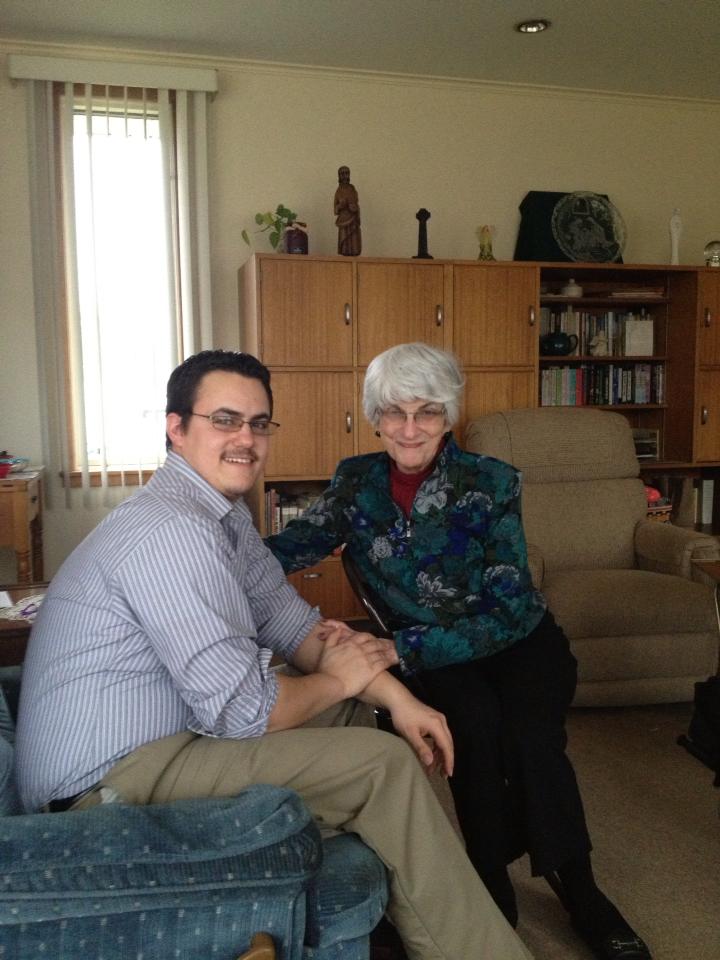
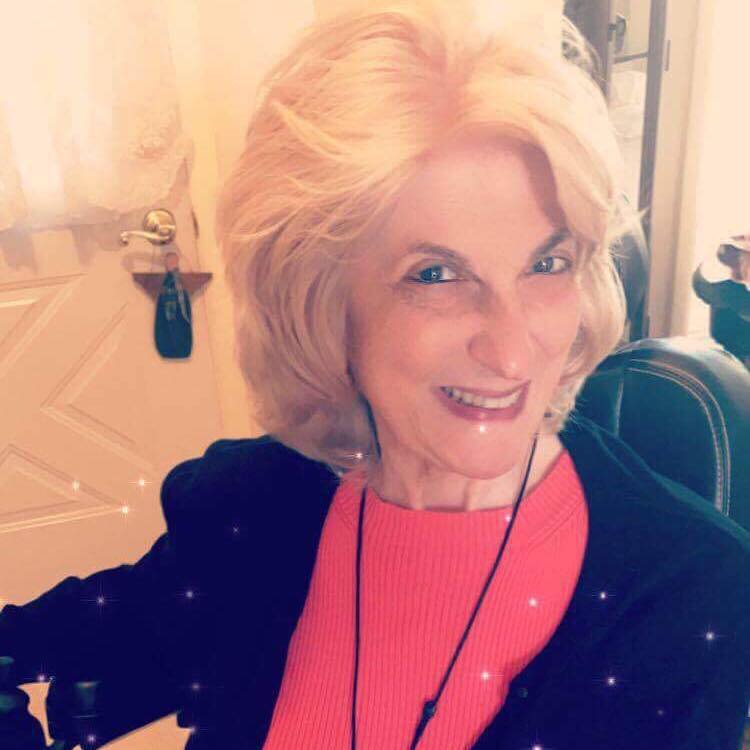
Hat-tip to my Aunt Jeneane, my dad’s sister, for the inspiration behind this project. After learning that I’d be traveling to Paris, she wrote to tell me that my great-aunt Penny (paternal aunt to my dad and his sisters) had always dreamed of going to Paris, describing the fabulous things she would see and do there. Aunt Penny was fabulous, through and through, from her brightly colored clothes to her extravagant accessories to the piano music and vocal melodies she could fill a room with at the drop of a hat. Thinking of her thinking of Paris made me smile. She would be such a natural there. 
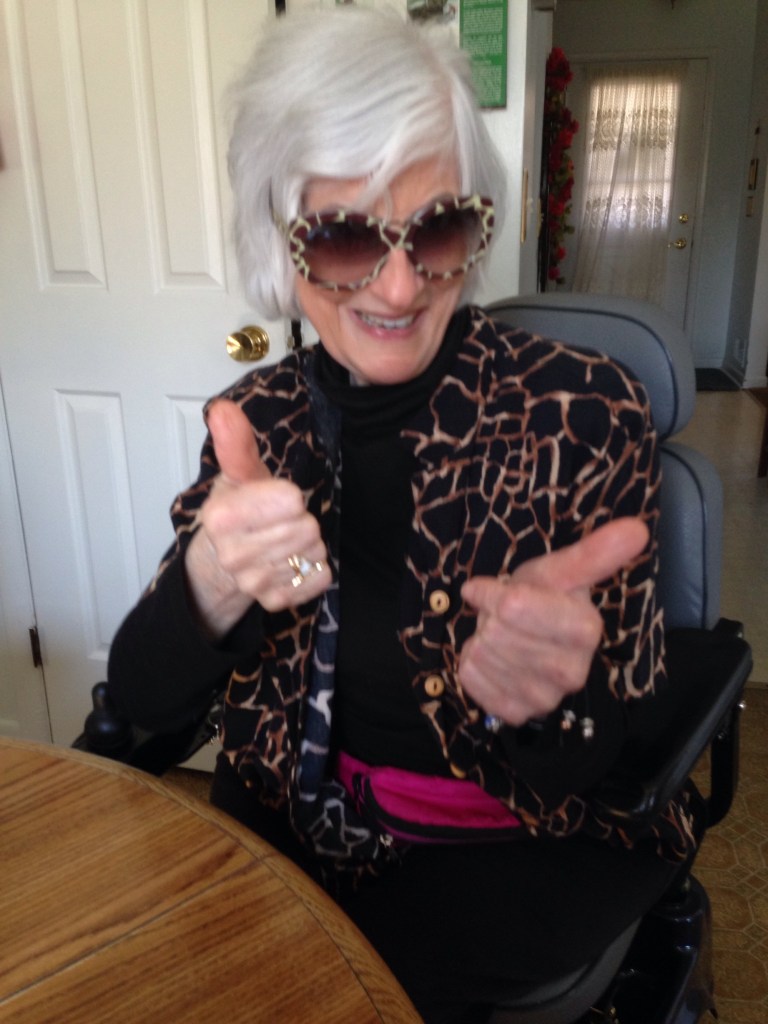
Aunt Penny passed away in 2020 before ever getting to make the trip. Aunt Jeneane asked if I might consider taking along with me something that reminded me of Aunt Penny and leaving it in Paris, so we could feel like she finally got to make that trip.

I was immediately on board and quickly knew exactly what I would take with me. Aunt Penny had quite a collection of Christmas jewelry, a large assortment of which came to me after she died. I love wearing her necklaces of tiny lights and her mini-ornament earrings during the holiday season. Given that we were traveling to Paris in December and it would be decked out in Christmas glory, I knew this was the perfect fit.

I chose four pieces from the collection, wrapped them carefully in tissue paper, and stowed them in a bag in my purse. As Rich and I strolled around Paris, taking in the twinkling lights, the smells of hot chocolate and mulled wine, and the decadent department store displays, we had such fun picking out precisely the right spots to leave an Aunt Penny trinket. I imagined her there beside me, her eyes gleaming as she took in the sights and sounds, exclaiming, “Oh, isn’t it wonderful?!”

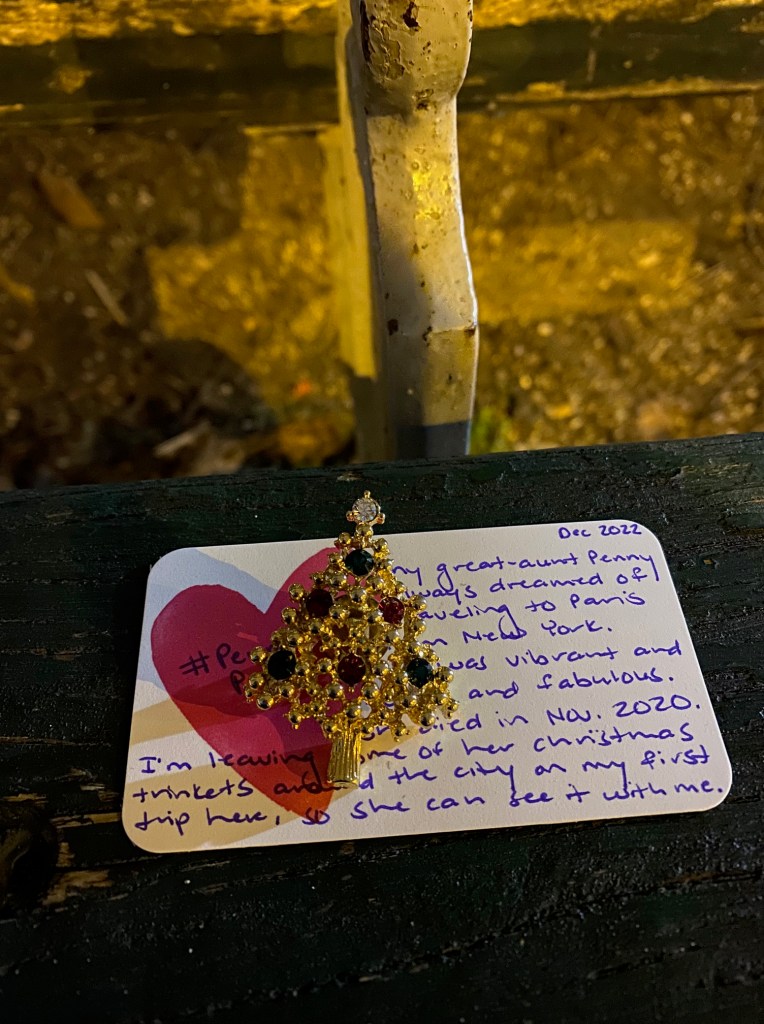
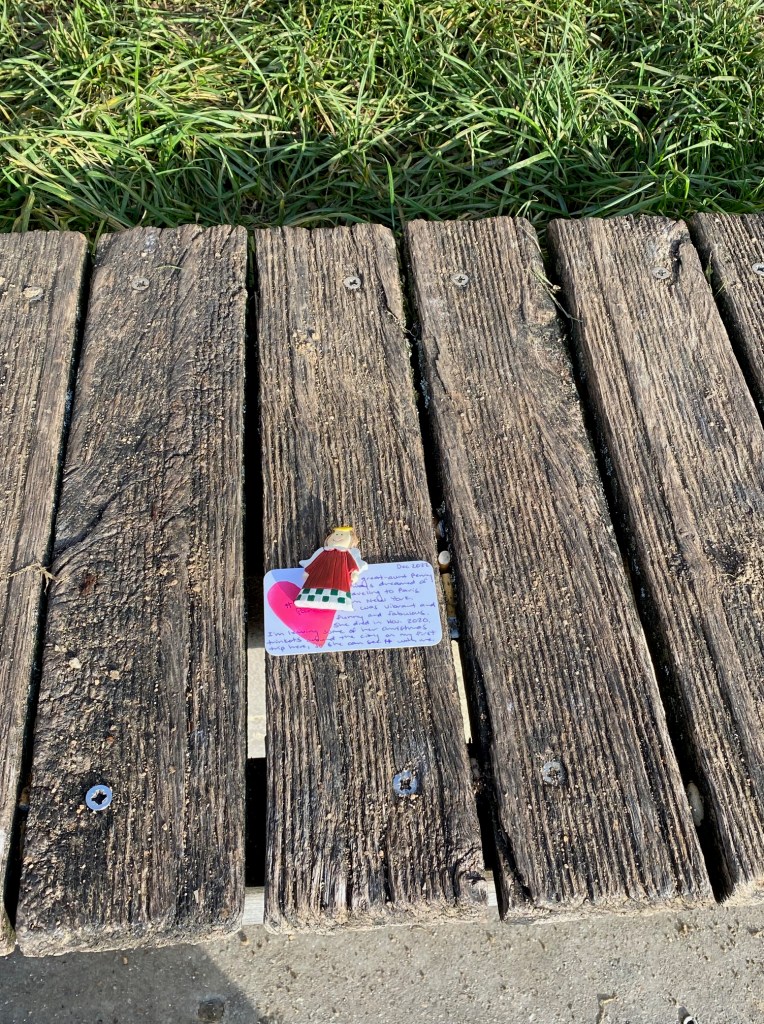
I didn’t feel quite right about leaving these sentimental objects by their lonesomes, so I wrote a little note to set with each one:

My great-aunt Penny always dreamed of traveling to Paris from New York. She was vibrant and funny and fabulous. She died in Nov. 2020. I’m leaving some of her Christmas trinkets around the city on my first trip here, so she can see it with me.

We placed a Christmas tree pin on the roof of the Galeries Lafayette department store, with a panoramic view of the city; another on a bench on the Champs-Élysées, lit up with row upon row of sparkling trees; an angel pin by a walking path along the Seine; and a jingle-bell bracelet in a park housing a Christmas market, with a view of Notre-Dame.

I included the hashtag #PennyinParis on the notes, and my Instagram and Twitter handle on the back, in the hopes of creating a sort of tracking to find out where the mementos ended up. I knew there were risks that the notes would be discarded, would never be seen, or would be difficult for a non-English-speaker to translate. (Only recently, upon the Italy trip, did I learn the wonders of Google Translate — what a gift!) 

Ultimately, it didn’t matter if I never heard from anyone — the point was that now it felt like Aunt Penny got to Paris

And then, about a week later, I heard from Tomi. 

He had found the card by the Seine, without its trinket, and messaged me on Instagram to let me know. He said he lives in a small village in northern France, that he’d found the card on a trip with his school class and was going to keep it on his bookcase. In our brief exchange, I could quickly tell that he understood the importance of Aunt Penny and this effort to honor her. “I really hope that she rests in peace,” he wrote. “I hope a part of her is in the card.”

This compassion was more than I had hoped for. I replied, “I believe there is a part of her in it and therefore now in your life.”

He agreed to give me his mailing address, and I sent him a couple other trinkets from the collection, a pin with Christmas beads dangling from it and a delicate string of mini imitation Christmas lights. On New Year’s Eve, I got a message that he’d received them and put them on his shelf with the card.

And so Aunt Penny continues to enjoy her Paris residency.

The guitar in the background of Tomi’s photo added a layer of emotional impact. I mentioned earlier Aunt Penny singing and playing the piano — my memories of her are wrapped warmly in music. There is a rich history of music on that side of the family. I’ve long heard stories of my great-grandmother’s house being filled regularly with family jam sessions, including my grandfather — my father’s father, Aunt Penny’s brother, Al — singing and playing the upright bass or guitar.

Which brings me to the next chapter of this adventure. 

A couple months ago, as my Italy trip neared, my dad asked if I might consider doing something similar to “Penny in Paris” on this trip, in honor of my grandpa. My dad is quiet-natured, cradling his emotions close to his chest but quick to sniffle when talking about his dad, who died of pancreatic cancer at the age of 38. My dad was 13 years old; his sisters were 15 and 6. Of course, I agreed immediately, feeling like I was being entrusted on a crucial quest. He gave me a tie clip and a set of cuff links that had belonged to my grandpa. 

Since first starting to plan our trip, Rich and I knew that the focus would be on Sicily and that we had to include a day trip to Grotte, the small town in Agrigento where both of my paternal great-grandparents were born, from which they immigrated to the US as children. We would be traveling with Rich’s sister, Allison; her wife, Maria; their youngest child, Marcie; and Maria’s brother, Tony, all of whom I adore. I was so grateful that they understood the importance of this trip and the added weight and excitement of it in connecting with my homeland. 

Before leaving, I talked with my great-aunt Marian (sister to Grandpa Al and Aunt Penny) and my dad’s cousin Mary Kay, both of whom had traveled to Grotte years before. I wondered if there were specific street names I should look for or any known relatives still in the area. They both were so excited about my trip and encouraging about my plans to see Grotte, although neither could offer many specifics. Aunt Marian described the area as quiet, simple, and folksy, with people sitting around outside, the women talking and the men playing cards. She told me it was very hilly and that street signs might not easily be found. Mary Kay regaled me of her adventure there pre-cell phones, pre-Internet, making her way by phone book in pursuit of remaining relatives. 

I was not at all discouraged by their descriptions. I felt I now had a sense of what to expect, a vision building of this quiet, slow-paced town. And it didn’t matter to me whether I found any relatives currently living there — I just wanted to set foot on the soil, walk the streets my ancestors walked, and know that this is where we come from.

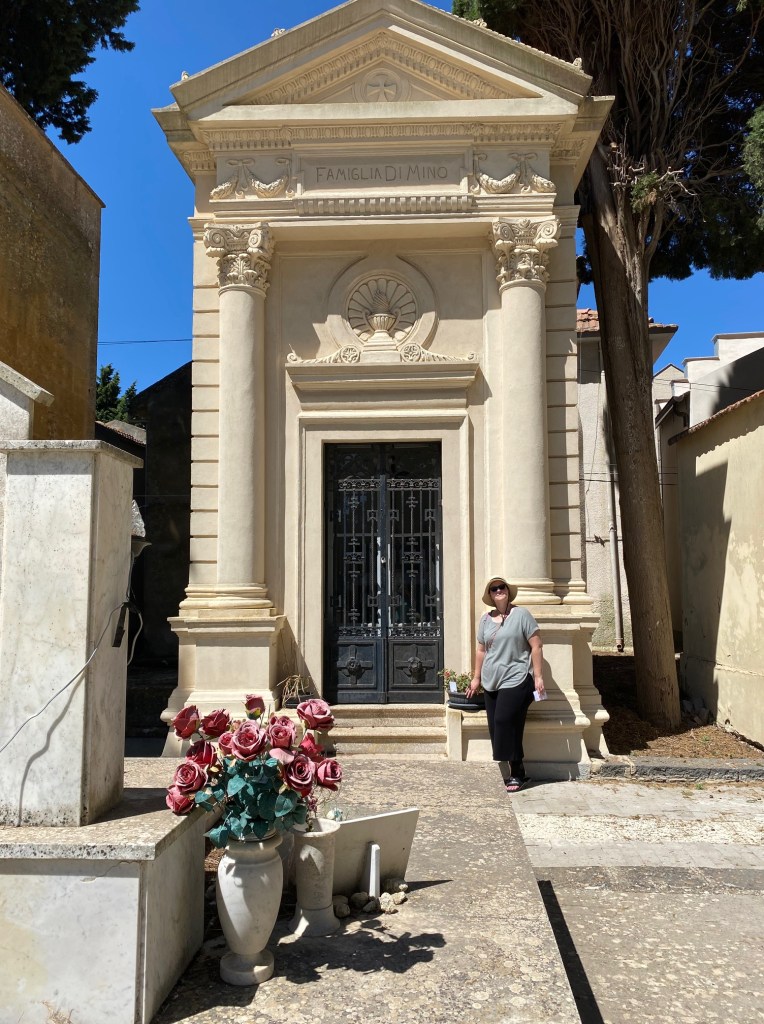
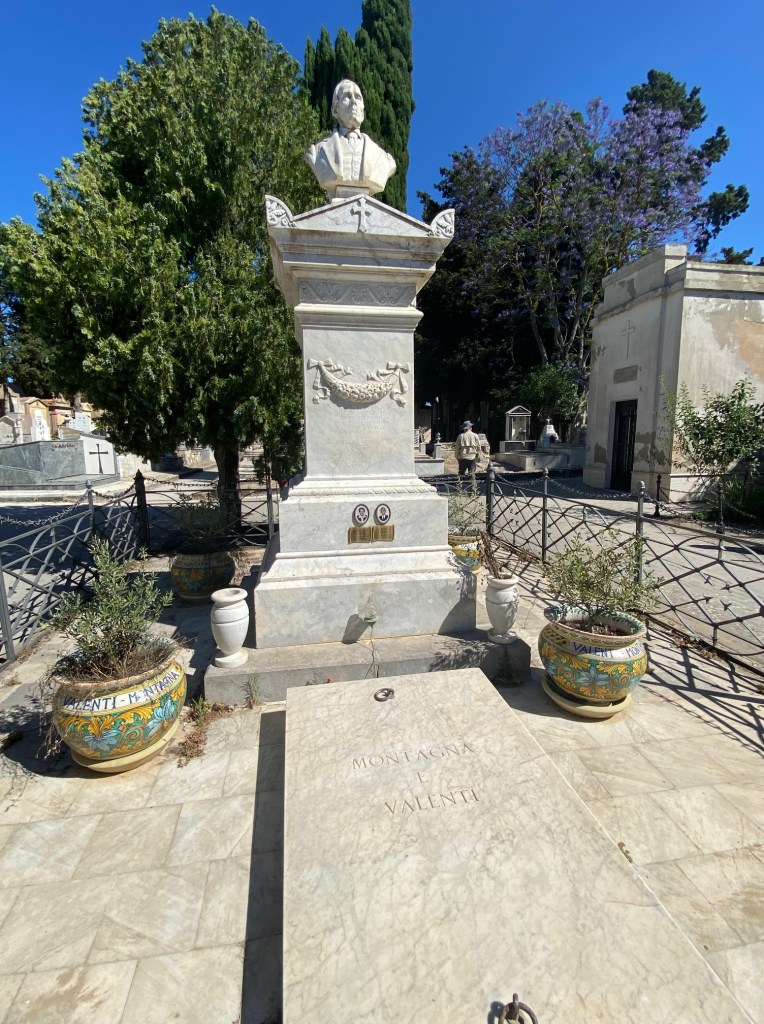
Our arrival in Grotte provided all of that and more. Thanks to the wise recommendation of a friend, we first visited the local cemetery, which I expected to be a tiny corner lot with centuries-old headstones in various states of disrepair. What we found instead was a seemingly endless sprawl of elaborate monuments, mausoleums, and engraved walls, many overflowing with fresh flowers. We could have spent a couple hours there and not seen everything.

Upon first walking in, we crossed paths with a few men working, whom I asked for permission to walk around. Using the aforementioned gift of Google Translate, I explained that my father’s family was from Grotte. They nodded and gestured, of course, come in, and asked about my family name. I mentioned not only Dimino but Valenti, my great-grandmother’s line, and one of the men smiled and pointed to a massive headstone just inside the entrance that bared the Valenti name.

We quickly found many more Valentis and Diminos as well as other names Rich had dutifully noted from his Ancestry DNA research on my behalf. We have a lot of research ahead of us to figure out which threads connect and where! It was such a thrill to walk around with that list of names, everyone taking pictures as they found matches and calling out to come see this or that. 
I was overwhelmed, in such wonderful ways.

The caretaker of the cemetery, an elegant and kind woman, spoke to me enthusiastically in Italian (thanks again, Google Translate!), trying to help ensure we could find what we were looking for. She seemed so deeply happy that we were there and trying to trace my roots, like I was being welcomed home by a stranger to a place I’d never been. She sent me off with a hug and a kiss.

I left the tie clip outside a Dimino family mausoleum, not sure (yet) if those Diminos are related but feeling like it appropriately honored the name’s presence in the area and the commemoration of those who have left us. 

Again, I wrote a note to accompany these trinkets:

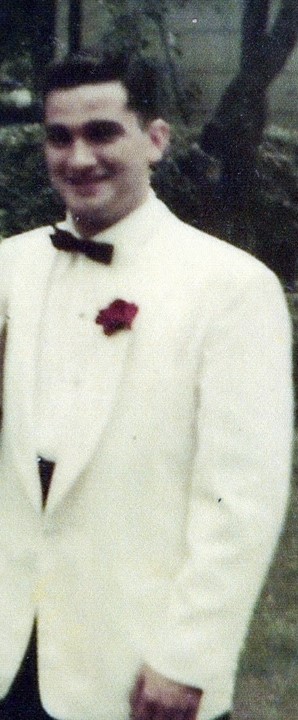
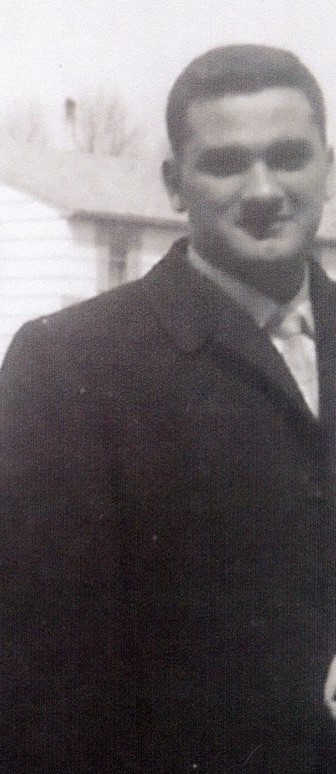
My grandfather – my father’s father – Alphonse Dimino, was a child of two American immigrants from Grotte, Francesco and Carmella (Valenti) Dimino. Al was a powerful presence, handsome and charming, a talented musician, and a loving family man, who died far too young.

On this first trip of mine to Sicily, I am honored to leave a little piece of him here in our homeland.

#GrandpaInGrotte

We ventured on into the town, sipping cappuccinos at a corner café, watching the old men sitting around chatting and the women bustling around with canvas bags on their shoulders. The man who had pointed us to that first Valenti headstone in the cemetery drove by and waved. Again, I felt so welcomed, so understood.

I wasn’t sure yet where I wanted to leave my grandpa’s cuff links. I felt a bit of pressure building as I wondered how I’d know what spot in this little area would be the right one.

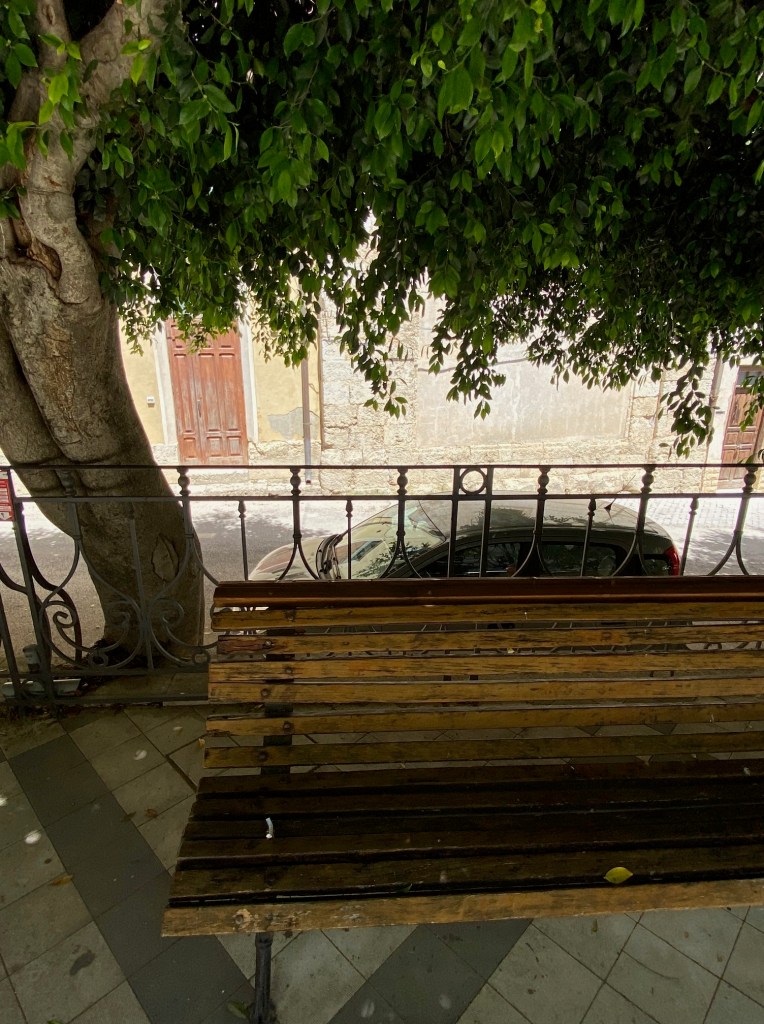
We strolled just a bit further, instinctively seeking some shade from a row of trees along a park-like stretch of sidewalk, lined with benches. And that’s when it felt precisely right.

Much like my visions of Aunt Penny enjoying the views from the benches of Paris, I imagined Grandpa Al sitting there on one of those Grotte benches, enjoying the shade and the breeze rustling through the trees. I looked out at the view he’d be seeing, of an inlaid stone street and buildings that had been there for centuries, and thought, This is the place.

Maria helped me roll the note up tightly so that we could slide it through the cuff links, hoping to ensure they wouldn’t get separated before someone found them. As I laid them down onto the bench, church bells rang out across the square. I was flooded with emotion, especially gratitude, in what felt like a cosmic moment between my grandfather and me.

My grandfather died when both he and his family rightfully assumed they had a lot of time left together. Aunt Penny died during the height of the COVID-19 pandemic, when so many gatherings were postponed with the thought that we’d make up for the lost time soon.

Tomorrow isn’t promised. Book the flight. Take the trip. And then, even when your feet are tired or the weather doesn’t cooperate or you’re hangry, savor every moment of it. 

I’ll be forever grateful that I did. 

Standing in the Mediterranean Sea

10 Reasons The Quiet Place Is the Ideal Getaway

I’m here today to let you in on a little secret. Perhaps it’s a poorly kept secret, as I keep discovering more people amidst my own network who are familiar with this Upstate New York gem — but, even then, it feels like we’re part of a really cool club. And I want more of you to get to experience it.

The Quiet Place Getaways are a group of properties nestled in prime locations throughout the Finger Lakes region. As the name promises, the focus is on quiet — you’ll have plenty of space to yourself and feel encouraged to slow down and appreciate your surroundings.

The accommodations range in size to suit anywhere from 2-6 people. Solo retreats are also an option (mostly at the 2-person properties; occasionally at a larger one, depending on availability). I highly recommend this for writers and any other creative types. It’s immensely productive!

The business of bookings and communications is centrally managed by a lovely husband-and-wife team, but each property is individually owned. They’re like a family, each member with its own unique personality and strengths. I don’t know if there’s a certain checklist to be included in the group, but there’s clearly a certain standard to be maintained, a particular vibe shared amongst them so that, browsing the properties, you quickly get a sense of the brand. Not just any place would make the cut.

I’ve been blessed to stay at several of these properties in recent years, and maybe I’ll write about the others another time, but first and foremost I need to tell you about the Naples Chalet, my favorite of the bunch. (Sorry, others; you’re great too!) This place played a critical role in the drafting and revising of my first book, provided a safe getaway during the height of the COVID-19 pandemic, and unexpectedly became a place for healing when I sprained my foot the night before one of my stays.

Coming here feels like nestling into my own little oasis. I walk up the gravel path, an expansive view rolling forth as I round the corner, where I always need to pause to breathe deeply and take it in. Standing here, I feel very small in the most moving way — there is so much to see and smell and hear, the open air stretched out endlessly before me, just from this one little spot. (That’s Canandaigua Lake visible just over the treetops.)

This view, walking up to the Naples Chalet, gets me every time.

Throughout my stay, I feel assured that every need has been thoughtfully addressed — and yet I’m left entirely to my own devices, in the best sense of the phrase. (And the best of both worlds for an introvert like me!) I don’t have to talk to anyone upon checking in, stand in a crowded elevator with chlorine-scented children dripping from a pool, or worry about neighbors having their TV on too loud or slamming their doors in the middle of the night.

While details vary across the properties, the general vibe and the goals are the same, with a focus on relaxing and recharging.

So, with some details here specific to my beloved Naples Chalet, here are 10 reasons why you should consider The Quiet Place for your ideal getaway.

1. It’s QUIET! You’re unlikely to cross paths with any other people while at your stay. If there are other houses anywhere in the vicinity, there’s some sort of unspoken understanding that this is a place for peace, calming, and reflection.

2. At the same time, it’s close to great food, wineries, trails, shops, and more. Naples, Canandaigua, and Bristol are a short drive, so if you want to be among people and find things to do, you’ll have plenty of options.

3. Beautiful views, surrounded by nature, are a standard accommodation. Every property has some combination of deck, porch, sunroom, and/or fire pit, to encourage you to soak up your surroundings.

4. Most properties have a hot tub and/or a soaking tub inside, for an added element of melting away your stress.

5. It’s well stocked with amenities — you’re away from it all but by no means roughing it. You’ll have that “off the grid” feeling while still having electricity, plumbing, heat / AC, and Wi-Fi!

6. The décor is gorgeous and creative, with so many fun little gems to discover. I love walking slowly around the Naples Chalet to see what touches have been added since my last stay. It demonstrates how much the owners care for their properties.

7. Likewise, there are always thoughtful hostess touches. When I step inside the Naples Chalet, I’m greeted by piano music playing softly from the stereo across the room, like I’ve just walked into a spa. Flowers and Hershey kisses grace the table. There are welcoming details at every turn: flyers and coupons for local restaurants and wineries, bottled water, and more fresh flowers in the bathroom and on the deck.

8. It’s the ideal atmosphere whether for a solo retreat (for me, focused writing and marketing time), a couple’s getaway, or catching up with friends. Slowing down and simplifying is a natural catalyst for reconnecting.

My workstation while at the Naples Chalet. I feel like I’m in a treehouse.

9. You’re working with a small group of local people for booking and during your stay, providing great communication and helpful guidance. They can talk you through which property is best for you or what to do while you’re in the area.

10. For all of this, the price is the same as (or less than!) what you’d pay for a nice hotel room — and you’re getting an entire experience.

All of this adds up to a justified investment in myself — my work, my mental health, my overall wellbeing.

I always leave a Naples Chalet stay wishing it could have lasted a bit longer and hoping I can carry home with me the sense of renewal and restoration it’s granted me. As I walk back along the gravel path, I again pause by the Adirondack chairs to take in that view one more time, breathe deeply, and meditate a moment on a flooding warmth of gratitude.

In Honor of Our First Book Birthday

This is a big month for Jessica and me and for our book. The Man Behind the Curtain: A Memoir is officially 1 year old!

And what a year it’s been:

My favorite local bookstore, Lift Bridge Book Shop in Brockport, New York, hosted our launch party. As I spoke to that room filled with loved ones, including several of my grad school professors who helped me form the earliest drafts of this book, I was overwhelmed with emotion and the surreal realization that We made it. This is really happening!

I wrote about takeaways from that first author event in a guest blog post for New Shelves, gurus of the publishing industry.

We also held author events with three libraries, a book club, and Writers & Books, a fabulous literary arts center in Rochester, New York.

We’ve been grateful to get on the shelves at so many wonderful shops and libraries. I’ve started a #shopsmall list here! If you don’t find us at your local library or book shop, please put us in contact or ask them to order the book through Ingram.

We’ve consistently remained among Amazon’s best sellers in the Teen & Young Adult Nonfiction on Sexual Abuse category, alongside names like Laurie Halse Anderson, Aly Raisman, and Chessy Prout, whom I revere and learned so much from in my research.

I was a guest on the Normal Lies podcast, which “challenges beliefs you thought were true about you and your world.” Host Linda Heeler was so compassionate with her questions and feedback.

I hosted a Zoom conversation called Trauma, Reclamation, & Healing with my friend Katie Baptist, a brilliant social worker, sex therapist, feminist, and fellow writer. We talked about what we’ve learned through our work and took questions from the audience. It was an inspiring conversation about silencing, speaking up, shame, and self-discovery.

Jessica and I were on air with WGNS Radio in Tennessee to talk about the book, the long-term effects of abuse (especially from childhood), tips for healing and for helping, the importance of delving into difficult conversations, and so much more. We’re grateful to host Scott Walker for his thoughtful discussion.

I launched my email newsletter, “Letting the Words Out,” sharing news about author events and other ways to get involved, plus highlights from the blog, my social media, life on the farm, and more. I’m looking forward to sharing some new writing-life updates there soon. You can subscribe here.

I’ve savored the growth of this blog, enjoying the creative outlet and opportunities for connection it provides. I appreciated the full-circle moment of blogging about the book’s publication and readers’ reactions, after having earlier introduced you to Jessica and posting a Q&A with her as we neared publication. This blog has been a part of the journey each step of the way.

Inspired by a friend’s generous suggestion, we launched a book donation campaign, asking you to consider purchasing a copy of The Man Behind the Curtain to donate to a place in your community where a new reader can discover it — a library, little free library, school, community center, nonprofit organization, etc. If you get in touch to let me know you’re interested, I’ll mail you a bookplate sticker to include in your donated copy!

We’ve appreciated powerful reviews from readers. If you’ve read the book (thank you!), please leave a review on Amazon or Goodreads as to how it impacted you. We love to hear from our readers, and that word of mouth is immensely helpful in connecting us with more readers!

Throughout all of this, the most amazing part has been the countless inspiring conversations we’ve had with fellow victims and allies. To know that this book is sparking conversation and helping others to feel understood, inspired, and hopeful — that’s exactly what we aimed to do in writing it.

As incredible as this journey has already been, there is so much more to come. It’s exciting to think of this book continuing to find its way into the world and into new readers’ hands.

We’re just getting started.

Many of these opportunities have required continuing to find new ways to challenge myself and step farther outside of my comfort zone. As a debut author and a self-published one to boot, I have to be willing to put myself out there.

But public speaking — the events in person, on Zoom, on the radio, on the podcast — made me nervous beforehand (and a little bit during).

And they left me buzzing with adrenaline and gratitude afterward.

While I’m not typically one to seek out the spotlight, I am one to seek out opportunities to generate discussion around the important (and admittedly difficult) themes our book addresses: abuse, victim shaming, the long-term effects of trauma — and how Jessica’s story is a shining example of the possibilities of rising above it all.

It’s no coincidence that our book’s birthday month is also Sexual Assault Awareness Month as well as National Child Abuse Prevention Month. While we wish there wasn’t still such a pressing need for these kinds of conversations, we’re honored to be a part of them and help further the cause however we can.

As we work to continue these discussions, Jessica and I humbly ask that you consider your contacts and help us make some new connections.

Who do you know who…

  • works with a school, library, bookstore, or nonprofit?
  • is part of a book club?
  • has a podcast or blog?
  • reviews books on Instagram, TikTok, or elsewhere?
  • writes for a magazine, journal, newspaper, or website?
  • has celebrity connections?
  • also speaks about triumph over trauma?
  • has some other literary or newsy interest?

We want to chat with them! Please comment here, send me their contact info, or send them mine, and I’ll be grateful to have a conversation about possibilities.

Sincere thanks to all of you who have helped make this year amazing and have helped this book spread its little wings and fly.

Thank you for continuing to help us pull back the curtain.

A Dream in Which I Tell Myself “I Would Do Anything for You”

I keep thinking about a dream I had several months ago. It was brief and blurry, but one element has remained persistently clear: I was sitting across from myself [a clone? A reflection? That part I’m not sure of, but there were two distinct yet identical presences of me], and the self that I embodied said to the other, reassuringly, matter-of-factly, “I would do anything for you.”

The caring was instinctive, deeply rooted, the way I feel in my waking hours about my boyfriend, my family, and my dearest friends — a level of protectiveness and pride I feel especially about my nieces and nephews: I don’t want anything bad to happen to you. You are strong and beautiful and talented. I believe in you. I’m here for you anytime. I love you beyond words.

Why don’t I treat myself that way?

Well, a couple months ago, several weeks after having had that dream and having it echo in my mind since, my self-care and -compassion were put to the test.

In one simple misstep, I slipped and fell in the yard, landing with one leg curled awkwardly beneath me and my foot bearing the weight of the rest of me collapsing. I’ve replayed that moment countless times since, as if I could retroactively change my footwear or my armload of stuff or whatever it was I stepped on that caused my foot to slip, and each time I’m struck by the notion that I had no idea in that instant how it would ripple out to affect the entire trajectory of my summer and my physical and mental health.

I don’t intend this to be a pity party nor to belabor the details, so I’ll give the abridged version:

  • The sprained foot led to a blood clot in my leg, which has continued to cause periods of swelling and discomfort as well as send my anxiety and depression on a seemingly endless roller coaster.
  • The prescribed blood thinner required me to stop taking another medication that had long been very helpful for me and left me scrambling for an alternative, none of which have proven satisfactory.
  • It was a hot summer to have one leg encased in a boot brace — although that brace has been a godsend in allowing me much better mobility than I had for the first few days, during which I couldn’t put weight on the foot without intolerable pain.
  • This whole experience has been an eye-opener as to how many elements of my typical day are not easily accessible, with any stairs, gravel, or hills leaving me unsteady at best and at times incapable of navigating without help. That is to say it’s opened my eyes to how very much I was taking for granted before.

The dream was not a stretch in that I have long been one to talk to myself — even out loud, even in public — but this too has now been manifesting in new, gentler ways: “We’ve got this,” I’ll say to myself. [We?! As if, again, there are two of us in the conversation!] “Okay, here we go. One step at a time.” I am aware that I am someone in need of caring and more willing to give myself that care than probably ever before. As I step slowly in and out of the shower or turn gingerly to rinse my hair, as I stretch my cramped-up calf muscle, as I climb into bed and appreciate the shedding of a long day, I am carrying myself differently, with more awareness, patience, and forgiveness.

While I wish it hadn’t taken an injury for this slowing-down to happen and I’m eager to start feeling more like myself again, I hope that as I continue to heal I can maintain this new perspective.

And I wish it for all of you, too — without the dramatic catalyst! Let’s adopt an attitude of showing up for ourselves. We need it more than we may realize.

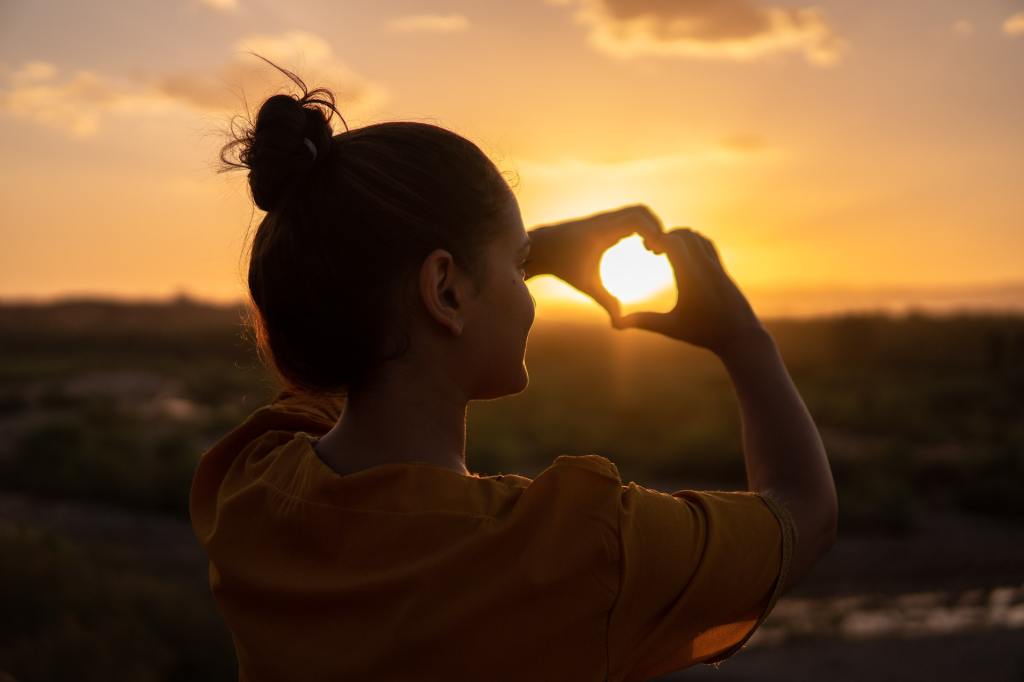
Photo by Hassan OUAJBIR, downloaded from Pexels

A Letter to My Nieces and Nephews, Growing Up in the COVID Era

Dear D, L, C, and E,

Sometimes I feel sad or angry that these past 19 months (and counting) of your childhood have been so heavily shaped by the COVID-19 pandemic. I do very often feel both sad and angry about all the time I’m missing out on with you and restless to get to the end of this difficult stretch so that I can be with you much, much more.

I recently found myself thinking of this strange time we’re in as “the lost years”: we’re missing out on so much, with plans continually cancelled, postponed, or dialed back. Again and again, we say “hopefully soon” or “maybe next year,” even though we’ve been taught to live in the present and not take a day for granted. So many things are on hold and uncertain, and it’s easy to feel frustrated, tired, and scared.

But then I get to see you or talk to you and am reminded that these years, these days, are not lost. You are continuing to grow, learn, laugh, and find joy throughout it all. You continue to give and inspire love so powerful, so unconditional, that I’m humbled to be a part of it. And you remind me that that’s what we should all be aiming for, always.

There is so much changing around you all the time, and yet you continue to roll with it and accept it. You understood when birthday parties had to be held by Zoom and dance classes had to be (still have to be) held with 6-foot squares taped out on the floor. You adapted to remote learning, and now you’re navigating being in school in person with so many added safety precautions and restrictions. You wear your masks without question and try hard to remember to keep safe social distances. You are much better about these things than many adults. You understand the big differences that little actions can make.

You run around playfully with your masks on. You give masked hugs or air hugs and say “I love you” on video calls. You ask me what kind of hand sanitizer we just used because “it’s a good one.” You make a game of changing your facial expressions, with exaggerated eyes, and seeing if I can guess whether you’re smiling behind your mask.

You tell me about the video game you’re playing, or the clubs and activities you’re starting, or the friends you’re making, or the boy in your class you think is cute, and the world feels normal again. You remind me of all the good there is in every day, and you remind me that I don’t want to lose sight of any of it.

You have more wisdom and clarity in your 9, 7, and 4 years than many of us have managed to acquire in decades. Given all that you’ve accomplished during these restrictive times, I can only begin to imagine all that you’ll achieve and inspire in others as the world continues to open its boundless self back up to you. Thank you for helping me to remember what matters and what’s good.

I love you more than words can ever say.

Love,
Vovo

Great Expectations of the Content We Consume

I’ve written before about the mixed emotions I feel as I near the end of a good book: there’s excitement to find out how it will end, a little worry as to whether I’ll be satisfied with that ending, and also a particular sort of sadness, deep in my rib cage, about parting ways with it. When I’m immersed in a great read, it can be so absorbing that I can’t help but leave part of my mind in the book’s world as I’m moving about in my own; the characters’ voices and predicaments continue to play out as if on a TV screen in the corner. I find myself wondering about them — how they’re feeling, what will happen to them. The haze of that other realm, the texture of the language, follow me around and beckon me to come back soon.

This is often true of TV shows and movies, too. While I enjoy creating my own vision in my head while I’m reading, the provided visuals and audio of the screen add so many more crevices to explore and cozy up with: the costumes, the sets, the actors’ vocal inflections and facial expressions, the music… (The music is utterly essential — I’m planning another post soon about the infinite ways music is tied to emotion and memory. Stay tuned!) Friends, The Office, Community, Gilmore Girls — I came to care about those characters and their worlds so deeply that I felt as if I truly knew them.

One of the things I’ve missed most during the pandemic is going to the movies. In recent years, I became a proponent of going to the movie theater alone. It’s the best way to allow yourself to become fully transported into the story. This is how I experienced some of my favorite films of the past few years: A Star Is Born, Bohemian Rhapsody, Rocketman (no coincidence about the run of music movies!), and my second viewing of Greta Gerwig’s Little Women (which I found mostly to be lovely but in many ways to fall short of the 1994 version, which happens to be my favorite movie of all time). I’m excited to say I recently ventured out to resurrect this tradition and see In the Heights. (Highly recommend.) As the opening musical number swelled and reverberated through the room, I was buzzing with adrenaline and such profound gratitude. I would argue that going to see a movie alone is nearly on par with attending a live concert in terms of savoring a fully immersive consumption of entertainment. And it’s a consumption of content — as a writer, it always comes back to that for me. Someone else has created this piece — these words, notes, visuals, etc. — and, in sharing it, has added content to my life. They have imparted an experience.

The ability of words on a page (or acted out on a screen, as the case may be) to make us laugh or cry or gasp is what solidified my dream of being a writer. I read a sappy Lurlene McDaniel novel in junior high and remember crying actual, full-fledged tears when one of the main characters died — and immediately afterward feeling a full-bodied awe at the fact that those tears were brought about by symbols on paper. I’d always been an avid reader and enjoyed making up poems and stories of my own, but that was the moment I knew: I want to do THIS.

We invest so much of ourselves in all of these types of content that it’s only natural to have such high demands of them — we invest not just time but emotion: hope, curiosity, vulnerability, the expectation of some sort of escape. We don’t want to be let down by the writers, the characters, the actors; we feel appreciative when they come through for us and impart an impactful experience.

The other side of that coin is that when we finish good content of any type, there is a mourning period of sorts. We emerge from that other world we’ve inhabited for however many hours and have to adjust to being back in our own familiar surroundings, often with a pang of longing — something, already, like nostalgia — for the friends and atmosphere we’d come to know.  

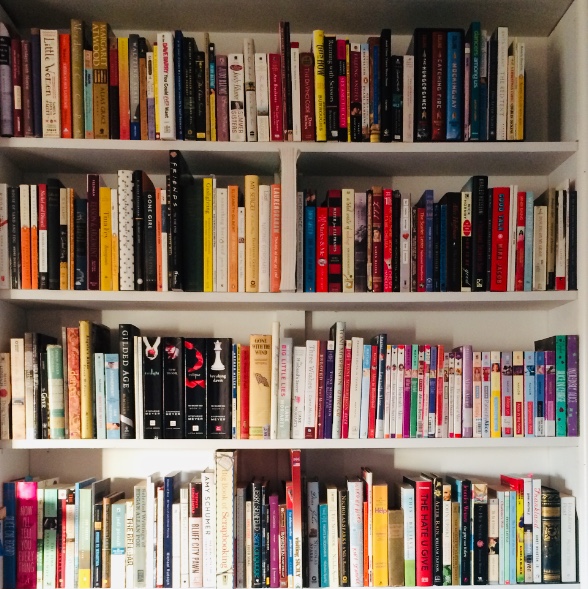
For me, though, the most exciting part of finishing a book is picking out which one I’ll read next. I’m a bit of a book hoarder. My multiple bookshelves are stuffed with favorites I hope to reread someday (or simply feel I must own, even if they don’t get reread in their entirety) and many, many books that I haven’t yet read. A small sampling — maybe 20 or so — are promoted to my bedside shelf as a sort of holding area for what’s to be read soon. There’s a pressure of sorts, an eagerness that borders on anxiety, as to picking the next read. What about all those others still waiting? Is this the one I’m ready for next? Choosing the next show or movie to cross off my to-watch list is a similar struggle. The thrill and uncertainty of these decisions, every time, speaks to the power that quality content has over us.

What great reads or binge-watches have you gotten lost in lately? Share your favorites with me — so I can add them to my ever-overflowing queues, calling to me as they wait in the wings.

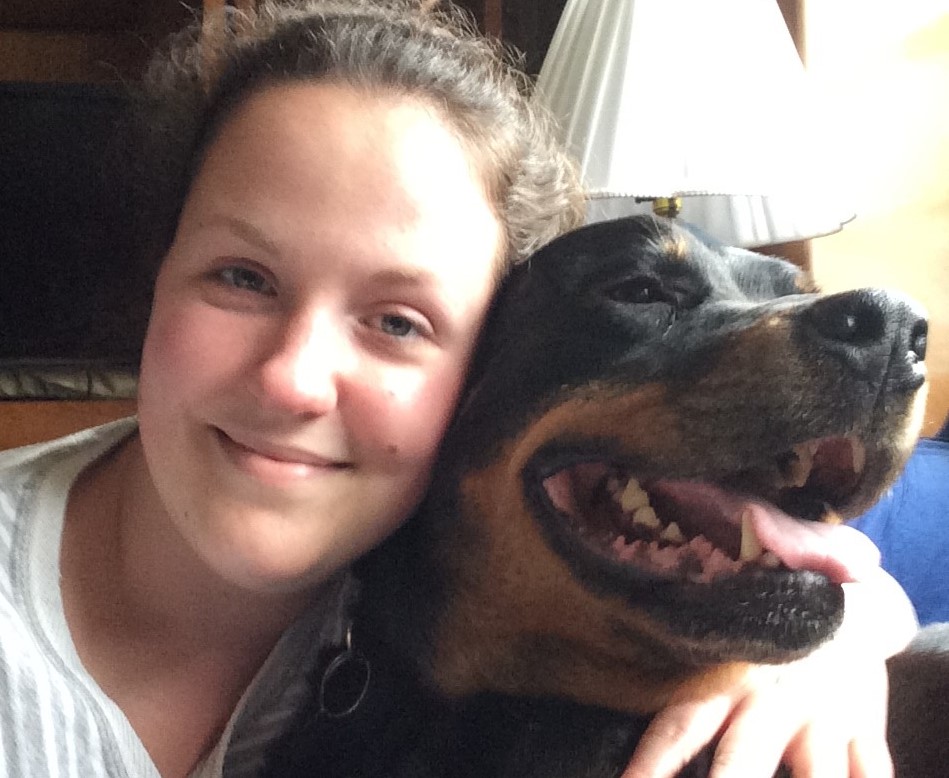
So many friends, old and new

We Need to Talk About Mental Health.

I have anxiety and depression.

People are sometimes surprised to hear this about me, because, I’ve been told, I come across as a generally upbeat, optimistic person. I try to see the good in everyone and everything. That is partially genuine and partially an effort to help myself focus on the good. Because I have anxiety and depression.

Sometimes I’m fine. Sometimes I’m pretending.

In our modern era of oversharing — inundated by social media feeds and phone notifications and email lists we keep meaning to unsubscribe from — somehow we still have trouble being open about the topic of mental health. Our own family members, close friends, and daily coworkers often hide the battles pressing against their chests. (I’ve done so in all of those interactions, and I’ve often learned of others’ battles only after knowing them closely for many years.) This is a critical failure. Those relationships could be lifelines — often literally — if given just a glimpse of the truths we refrain from speaking.

There’s a cruel cycle at play here: for many of us, a key reason we don’t tell others about what we’re dealing with is the negative self-talk that is so inherent in these conditions (and thus only makes them more urgent): People will think I’m weak, pitiful, not good enough, not up for X, Y, Z. This is especially true when there’s a power issue involved (eg, My boss won’t trust me with that project / won’t think I deserve that promotion) but can be true of even our closest relationships with people who think the world of us. Our rational selves know that those people would not judge us. But our self-image is often vastly different from what others perceive of us.

And, of course, the longer we suppress those feelings, the worse they can get; the longer we avoid those conversations, the harder they are to have.

The COVID-19 pandemic has undoubtedly amplified these struggles for countless people and brought on new issues for still more. It can be hard to find the light amidst this long stretch of dark days, during which we’re battling loneliness, fear, and the disappointment of postponed or cancelled plans. I suspect these days we’re all some level of anxious, depressed, or both.

So, I want to share a bit about my experiences, in the hope that it might help others, whether you’re struggling, too, or could be in a position to help people around you who are.

My anxiety makes me feel restless, my thoughts obsessive, my brain unable to quiet down. My depression makes me not want to move, or to feel unable to move. These can be in play simultaneously. It most often happens at night, my mind lit up and spinning like a carnival ride at the same time that my body feels weighed down by a concrete blanket. My body aches for sleep, but my mind won’t let it happen, sometimes for hours.

Writing, exercising, cleaning, or some other burst of productivity will sometimes help lift me out of a depressed stretch or quell my anxiety, as will social time with family or friends. Sometimes, those things don’t help, or they make things worse, or I can’t bring myself to try.

Unfortunately, these feelings typically can’t be explained; it’s not as simple as asking “What’s wrong?” and applying X solution. Yes, sometimes there may be a catalyst that brings on an episode or spurs it into overdrive, but ultimately I’m feeling those things simply because I have anxiety and depression. They are chemical processes that flare up and, thankfully, recede. The lack of an explanation can be confusing for those around me — and for me, too! I ask myself, Why do I feel this way? and think, I shouldn’t feel this way, as my mind rattles off the countless great things in my life.

And then I feel even worse: ungrateful, guilty, and like something must really be wrong with me, if I’m unable to snap out of it when I should have no excuse for feeling down. 

Thankfully, this all happens far less often for me in recent years than it did for many years before. There is no question that this is because I’ve put in 8 years of work through counseling (more on that below) and continue to use the tools I gained there. Personally, I’ve chosen not to take medications, as I wanted to focus instead on understanding my processes and triggers and learning how to work through them. But I know many people for whom medications have made all the difference, and choosing to forgo them wasn’t a decision I made lightly. The choice to medicate, and which one(s) to use, is highly individualized and can be a long process.

Some things that have helped me:

  • COUNSELING! Sooo much counseling. Talking to a professional proved to be absolutely essential for me, even on days when I thought I wasn’t up for it; even on days when I thought I had nothing to say. With time, building that trust and opening up in those sessions helped me to offload tension, gain perspective, communicate better, and listen to myself. Just knowing I had that outlet available — that my next appointment was coming up soon, that I could ask that question or share that progress — came to be such a comfort.
  • Learning that self-care is time well invested. It may be some of the best time invested, the most important. “Mental health days” can be hard to give ourselves permission to take — we worry they’ll be a sign of weakness or laziness or will invite suspicion: Is she really sick? But if our mental and emotional health aren’t cared for, our physical health, our work quality, and our relationships all suffer.
  • As I’ve written about before, gratitude has played a huge role in my wellbeing and is something I continue to put into practice. I love Gretchen Rubin’s Happiness Project one-sentence journal for its simple focus on daily small moments of joy. It has helped me find light during darker days and to remember that things always get better. It’s the only journal I’ve stuck with consistently for any significant length of time. I recently completed a full 5-year journal and started my next one!

Some things you can do to help:

  • Be willing to talk about it. And be willing to listen. Make sure your loved ones know that you’re available for these conversations.
  • Understand that trying to “fix” the situation may not be the best approach. Even when meant as reassurance, saying, “Why don’t you just do this?”or minimizing the person’s concerns as “no big deal” can feel dismissive. Just letting them get some words out (much like in a counseling session) can be so helpful. Maybe ask if they’d like advice, or ask how you can be helpful. And just make sure they know they are heard and valued.
  • Equally important is a willingness to respect their space and their process. For me, anxiety and depression sometimes mean I’m not up for talking or being social or that I have trouble following through on plans, despite my best intentions. It’s nothing personal (even though I worry obsessively that others will see it that way). With a little time, I’ll work through it, and all will be well.

Of course, the perspective I share here is just mine, and others’ will differ in many ways. We each walk a unique journey. But I hope we can work on developing a shared understanding that we need each other, can learn from each other, and can all grow from being willing to talk about the things we too often keep hidden.

Photo by Burst, of what is clearly my spirit animal, downloaded from Pexels

On Grief and Gratitude

The first thing you need to know about Leah is that she wasn’t “just” a dog. She was the first dog I had in my adult life, in my first house, navigating her care around my first full-time job. I brought her home when she was just a few months old, small enough to rest up against my shoulder like a baby or curl perfectly into the triangle of my criss-cross-legged lap. In so many ways, we grew up together.

We challenged each other and supported each other through a whole lot of ups and downs. We navigated sleepless nights — in the beginning and again near the end, months of housebreaking issues, and various training approaches. I nursed her back to health after multiple illnesses and surgeries, including an ACL repair that meant no running or jumping for two months. I put my mattress on the floor so she could still sleep next to me and guided her outside, step by tedious step, using a towel as a harness.

She returned the care I gave her tenfold. When I was stressed out or crying, she would lay her head in my lap or bring me a toy, reminding me to take a breath and laugh it off. When I slipped on ice while walking her once, she immediately came close to my side and bent down, a confused but ready protector. She was a friend to all of my friends, an adored grandpup, a charmer to our neighbors (even a couple who said they otherwise didn’t like dogs), and a calming, neutral-party mediator between my ex-husband and me, as we navigated coparenting her after we split.

Through the divorce, three moves, two job changes, and a master’s degree, she was on the journey alongside me. Amidst all the changes, she was a constant.

For the last few years, it was just the two of us in our little apartment. I talked to her all the time. I still do.

grief_gratitude_facebook_screenshot

And now she’s gone.

She passed away in July, after a brief and rapid decline into kidney and liver failure. She was 8 years old. Those 8 years felt like a lifetime and a fleeting moment, all at once. It still feels so strange to talk about her in the past tense.

Without her, I have now entered a new phase that feels foreign and tricky to navigate. A chapter in which I was quite comfortable was closed before I was ready, and a new one now stretches out before me. This is one of the most palpable experiences I’ve had of life operating outside of my control. I see myself now as a character standing upon that new chapter’s blank pages, trying to figure out what comes next.

This change has been heartbreaking and scary — and also, when I allow it to be, filled with new possibilities. I’ve barely known an adult life that didn’t include making plans around dog care, and I don’t quite know what to do with it yet. I’m trying to gain an appreciation for the more flexible schedule and the lessened responsibility, but most days I would rather go back to the 2 am wakeups and the snowy walks and the vet bills if it could mean having her back.

One thing that’s guiding me through this is the refreshed perspective I’ve had toward life since entering a previous new phase about a year ago. Last fall, I left the job I’d been in for 6 years and entered a new field, gaining a revitalized outlook and energy in the process. I got serious about my health — not just physically but mentally and emotionally too. Happiness and gratitude became priorities. I’ve found that, by simply paying better attention and shifting my focus, there is so much to be grateful for in every day. I work hard to acknowledge it, rather than mindlessly let it slip past or, worse, let the negatives take over my attention.

As I’ve talked with many loved ones and with my counselor about losing Leah, I find myself returning again and again to gratitude, falling into those kinds of statements without even trying — gratitude for the time we had together, for all that she taught me, and even for the ending we were given. I’m finding that gratitude is what sustains us during the times when it’s particularly hard to feel grateful.

I’m grateful that I can say Leah’s decline was brief. Just a month before she passed, she’d had a great annual check-up and had more energy than she’d had in months. Her dad took her to the beach and took stunning photos of her with a happily tired, wide-mouthed smile. I will cherish those all the more so now, because I want to think of her that way — loving life and savoring a beautiful day. She loved lying out in the sun.

I’m grateful that, shortly after Leah first went to the vet that Saturday morning, I had a girls’ day out and sleepover with my niece, Cora, that kept my focus on something positive while waiting for an update. (The vet needed to keep Leah there for the weekend on an IV.) Cora and I had had these plans set for weeks, and I didn’t want to cancel. When I got the call Sunday morning that Leah was not improving and I should get there soon, I’m grateful that Cora displayed maturity far beyond her 5 years in understanding the change in plans and getting herself dressed and packed while I made a flurry of phone calls. I’m grateful I have some positive memories associated with that weekend thanks to her.

I’m grateful that we had a heads-up that the end was coming and were able to be with Leah for her final breaths, as difficult as that was. I’m grateful the decision we had to make that day was clear, as she was no longer herself and was not going to bounce back. There was no agonizing uncertainty or wait; she had gone a long way down a dark road very quickly, and we helped her along the rest of it. I’m grateful that my ex, his new wife, and I were all there together to remind Leah of how much she is loved and to support each other through this overwhelming loss, as we’ve continued to do.

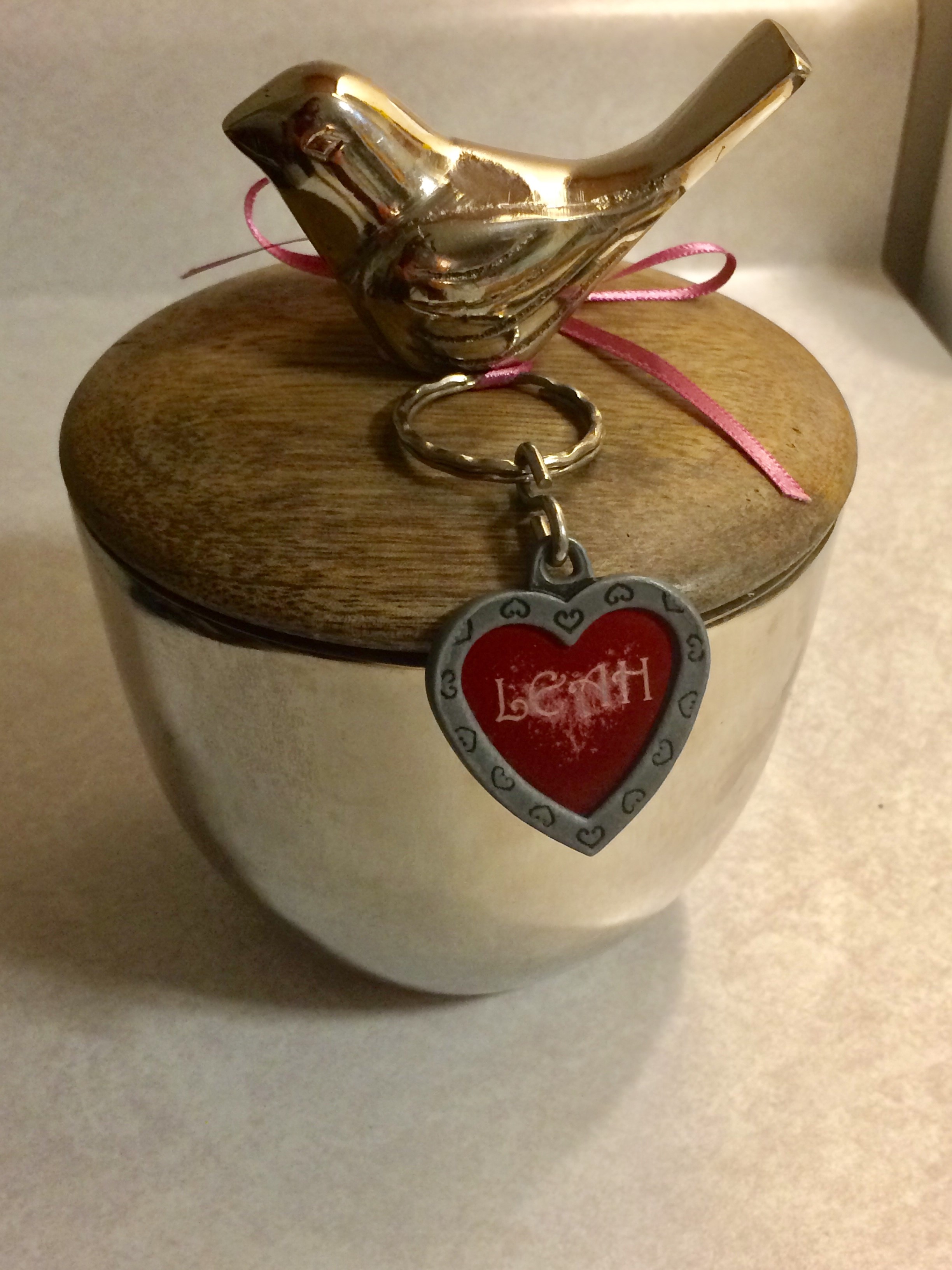
I’m grateful that I stumbled upon the perfect “urn” at the At Home store after debating for weeks what to do with Leah’s ashes. Nothing had felt right. And then this little tin with a bird on it was waiting for me at the end of an aisle, the only one of its kind. I picked it up and carried it around the store with me, and instinctively I found myself holding it close, almost cradling it, rubbing the bird’s back mindlessly with my thumb. I felt comforted, reassured. Not only do I think of birds as a symbol of peace, but Leah loved to chase after them and bark at them, hopping around as she looked up at them in the trees. It felt like a sign, at a time when I had long been ready to receive one.

grief_gratitude_urn

I’m grateful for all the lessons and challenges Leah brought to my life, for how much she helped me to grow, for her snuggles and playtime routines and the way her eyes would light up as we rounded the last corner of our walks and ran to our door. I’m grateful for all the little pieces of each day that will always make me think of her.

As daily life carries on amidst this jarring change, I still often endure waves of grief, but I return again and again to gratitude. It’s going to take continued practice and mindful effort, and I know there will still be days I fail at it. But I’m grateful I had already laid that foundation and can try to call upon it now, when I need it more than ever before.

Losing Leah has been such a profound loss precisely because of how fortunate I was to have her as an integral part of my day-to-day life. The key is to try to keep my focus on that second part and let that swell of gratitude continue to carry me forward.