
Up until this past December, I had never traveled out of the country other than to various areas of Canada — which, as a Western New Yorker, is nearby enough to hardly feel like a change of territory.
I’m blessed that my fiancé, Rich, values traveling and that we have the means to do so. Regardless of your travel inclinations or abilities, I hope you can gain some inspiration from what I share here, whether it’s about taking the trip of a lifetime, exploring your own neighborhood through a new lens, or honoring your family roots in a creative way.
In December, Rich and I went to London and Paris, and we recently returned from a trip to Italy. I have so much to say about both trips, and I hope to write more soon with a broader overview, but first I have to process my thoughts on what were easily some of the most impactful moments of these trips, both involving symbolic gestures to honor family. Emotions will ensue.
Hat-tip to my Aunt Jeneane, my dad’s sister, for the inspiration behind this project. After learning that I’d be traveling to Paris, she wrote to tell me that my great-aunt Penny (paternal aunt to my dad and his sisters) had always dreamed of going to Paris, describing the fabulous things she would see and do there. Aunt Penny was fabulous, through and through, from her brightly colored clothes to her extravagant accessories to the piano music and vocal melodies she could fill a room with at the drop of a hat. Thinking of her thinking of Paris made me smile. She would be such a natural there.
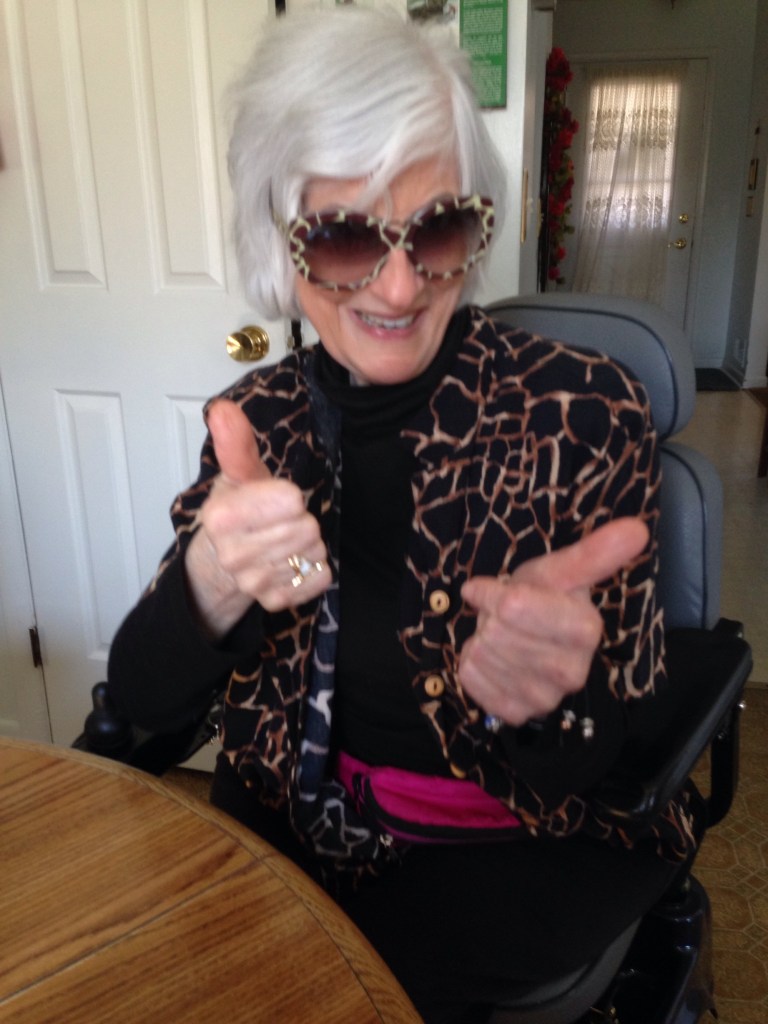

her godson

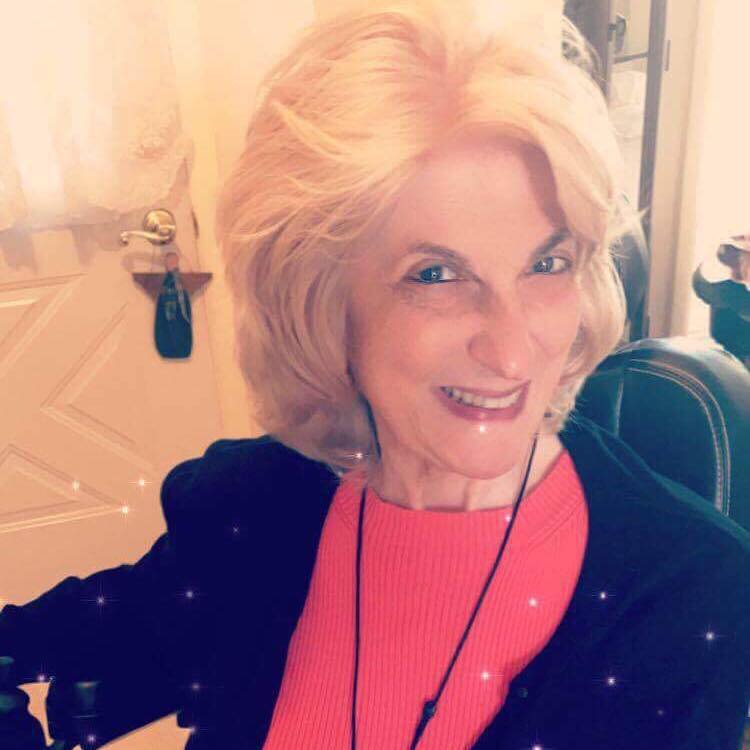
Aunt Penny passed away in 2020 before ever getting to make the trip. Aunt Jeneane asked if I might consider taking along with me something that reminded me of Aunt Penny and leaving it in Paris, so we could feel like she finally got to make that trip.
I was immediately on board and quickly knew exactly what I would take with me. Aunt Penny had quite a collection of Christmas jewelry, a large assortment of which came to me after she died. I love wearing her necklaces of tiny lights and her mini-ornament earrings during the holiday season. Given that we were traveling to Paris in December and it would be decked out in Christmas glory, I knew this was the perfect fit.
I chose four pieces from the collection, wrapped them carefully in tissue paper, and stowed them in a bag in my purse. As Rich and I strolled around Paris, taking in the twinkling lights, the smells of hot chocolate and mulled wine, and the decadent department store displays, we had such fun picking out precisely the right spots to leave an Aunt Penny trinket. I imagined her there beside me, her eyes gleaming as she took in the sights and sounds, exclaiming, “Oh, isn’t it wonderful?!”
I didn’t feel quite right about leaving these sentimental objects by their lonesomes, so I wrote a little note to set with each one:
My great-aunt Penny always dreamed of traveling to Paris from New York. She was vibrant and funny and fabulous. She died in Nov. 2020. I’m leaving some of her Christmas trinkets around the city on my first trip here, so she can see it with me.
We placed a Christmas tree pin on the roof of the Galeries Lafayette department store, with a panoramic view of the city; another on a bench on the Champs-Élysées, lit up with row upon row of sparkling trees; an angel pin by a walking path along the Seine; and a jingle-bell bracelet in a park housing a Christmas market, with a view of Notre-Dame.


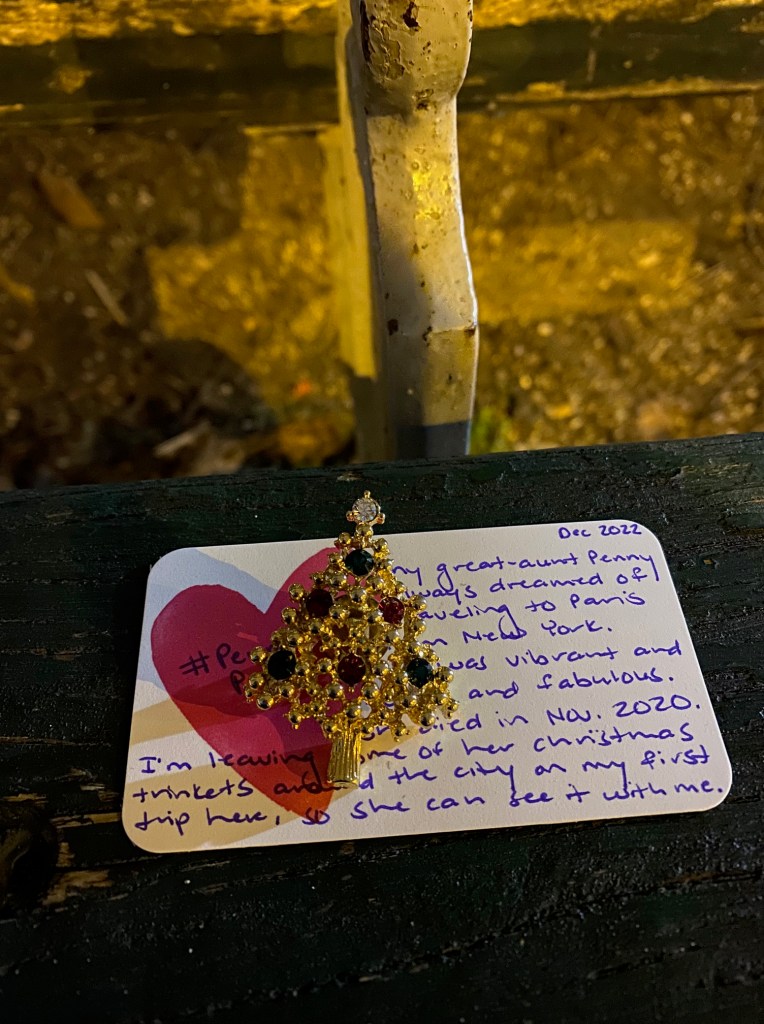

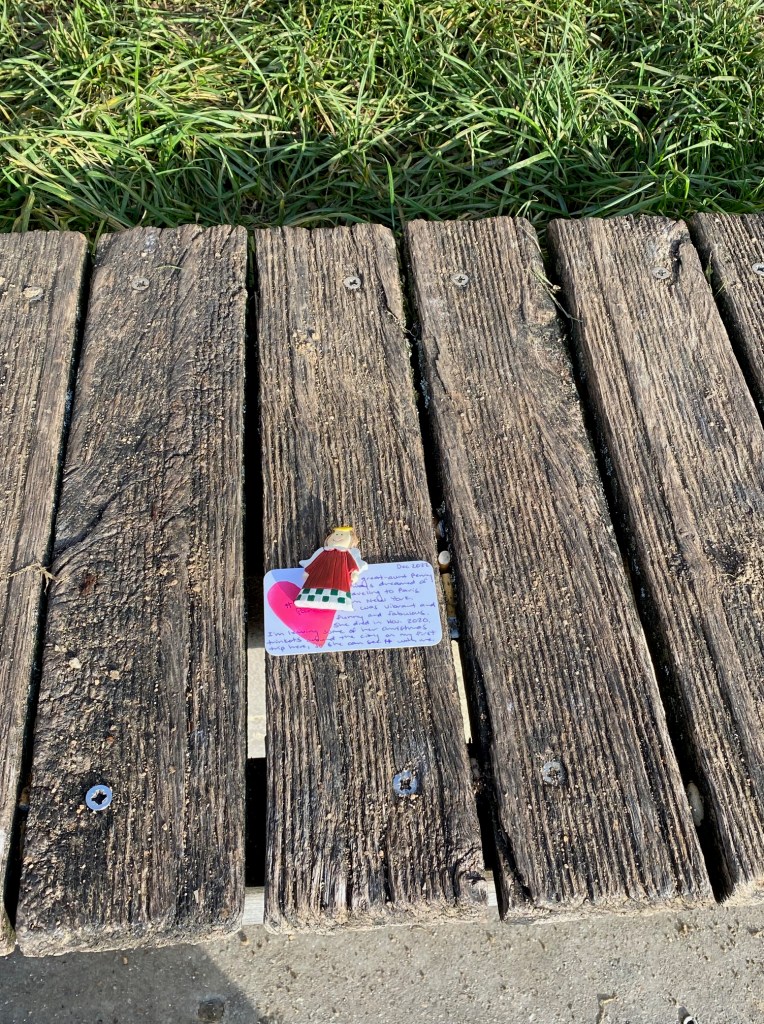


I included the hashtag #PennyinParis on the notes, and my Instagram and Twitter handle on the back, in the hopes of creating a sort of tracking to find out where the mementos ended up. I knew there were risks that the notes would be discarded, would never be seen, or would be difficult for a non-English-speaker to translate. (Only recently, upon the Italy trip, did I learn the wonders of Google Translate — what a gift!)
Ultimately, it didn’t matter if I never heard from anyone — the point was that now it felt like Aunt Penny got to Paris.
And then, about a week later, I heard from Tomi.

He had found the card by the Seine, without its trinket, and messaged me on Instagram to let me know. He said he lives in a small village in northern France, that he’d found the card on a trip with his school class and was going to keep it on his bookcase. In our brief exchange, I could quickly tell that he understood the importance of Aunt Penny and this effort to honor her. “I really hope that she rests in peace,” he wrote. “I hope a part of her is in the card.”
This compassion was more than I had hoped for. I replied, “I believe there is a part of her in it and therefore now in your life.”
He agreed to give me his mailing address, and I sent him a couple other trinkets from the collection, a pin with Christmas beads dangling from it and a delicate string of mini imitation Christmas lights. On New Year’s Eve, I got a message that he’d received them and put them on his shelf with the card.
And so Aunt Penny continues to enjoy her Paris residency.
The guitar in the background of Tomi’s photo added a layer of emotional impact. I mentioned earlier Aunt Penny singing and playing the piano — my memories of her are wrapped warmly in music. There is a rich history of music on that side of the family. I’ve long heard stories of my great-grandmother’s house being filled regularly with family jam sessions, including my grandfather — my father’s father, Aunt Penny’s brother, Al — singing and playing the upright bass or guitar.
Which brings me to the next chapter of this adventure.
A couple months ago, as my Italy trip neared, my dad asked if I might consider doing something similar to “Penny in Paris” on this trip, in honor of my grandpa. My dad is quiet-natured, cradling his emotions close to his chest but quick to sniffle when talking about his dad, who died of pancreatic cancer at the age of 38. My dad was 13 years old; his sisters were 15 and 6. Of course, I agreed immediately, feeling like I was being entrusted on a crucial quest. He gave me a tie clip and a set of cuff links that had belonged to my grandpa.

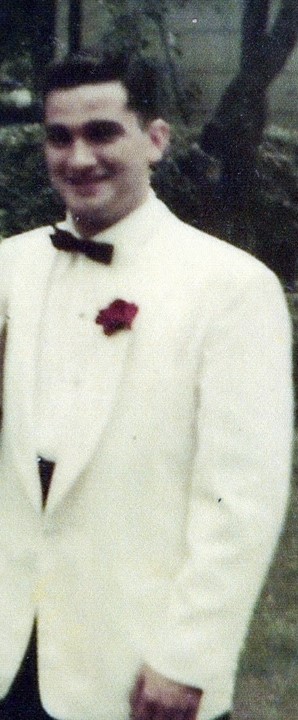
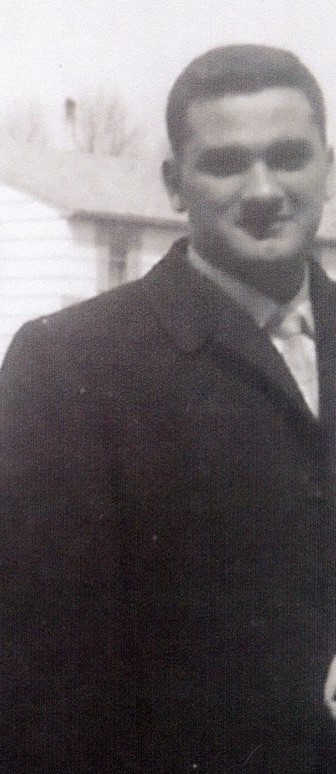
Since first starting to plan our trip, Rich and I knew that the focus would be on Sicily and that we had to include a day trip to Grotte, the small town in Agrigento where both of my paternal great-grandparents were born, from which they immigrated to the US as children. We would be traveling with Rich’s sister, Allison; her wife, Maria; their youngest child, Marcie; and Maria’s brother, Tony, all of whom I adore. I was so grateful that they understood the importance of this trip and the added weight and excitement of it in connecting with my homeland.
Before leaving, I talked with my great-aunt Marian (sister to Grandpa Al and Aunt Penny) and my dad’s cousin Mary Kay, both of whom had traveled to Grotte years before. I wondered if there were specific street names I should look for or any known relatives still in the area. They both were so excited about my trip and encouraging about my plans to see Grotte, although neither could offer many specifics. Aunt Marian described the area as quiet, simple, and folksy, with people sitting around outside, the women talking and the men playing cards. She told me it was very hilly and that street signs might not easily be found. Mary Kay regaled me of her adventure there pre-cell phones, pre-Internet, making her way by phone book in pursuit of remaining relatives.
I was not at all discouraged by their descriptions. I felt I now had a sense of what to expect, a vision building of this quiet, slow-paced town. And it didn’t matter to me whether I found any relatives currently living there — I just wanted to set foot on the soil, walk the streets my ancestors walked, and know that this is where we come from.
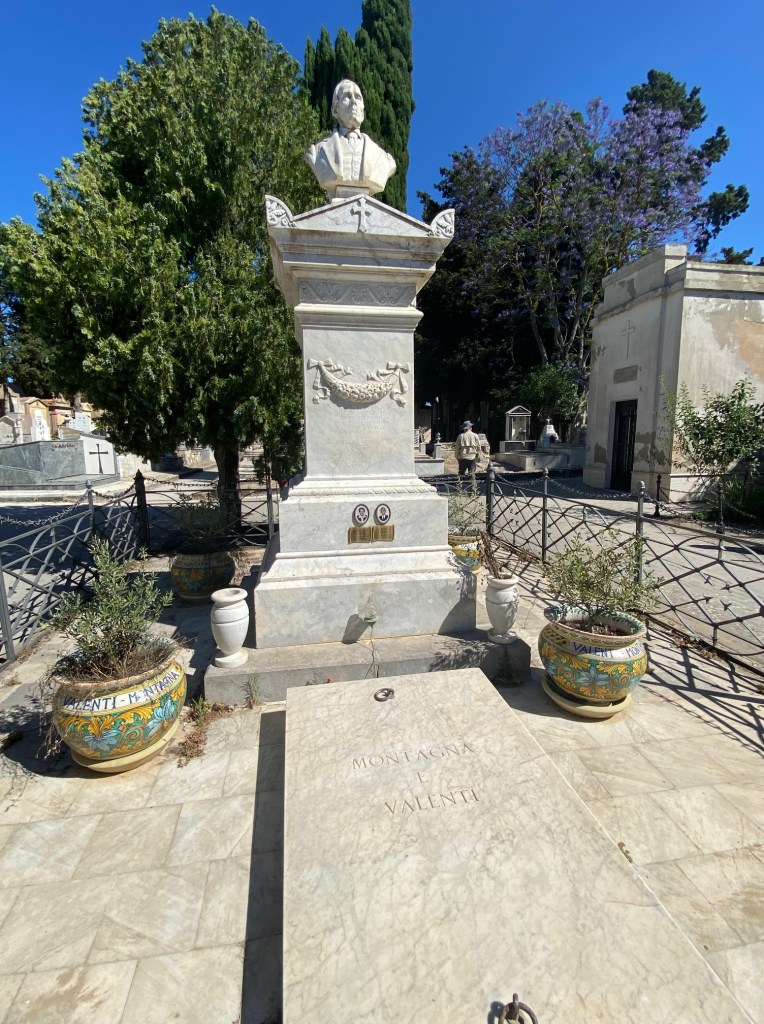
Our arrival in Grotte provided all of that and more. Thanks to the wise recommendation of a friend, we first visited the local cemetery, which I expected to be a tiny corner lot with centuries-old headstones in various states of disrepair. What we found instead was a seemingly endless sprawl of elaborate monuments, mausoleums, and engraved walls, many overflowing with fresh flowers. We could have spent a couple hours there and not seen everything.
Upon first walking in, we crossed paths with a few men working, whom I asked for permission to walk around. Using the aforementioned gift of Google Translate, I explained that my father’s family was from Grotte. They nodded and gestured, of course, come in, and asked about my family name. I mentioned not only Dimino but Valenti, my great-grandmother’s line, and one of the men smiled and pointed to a massive headstone just inside the entrance that bared the Valenti name.
We quickly found many more Valentis and Diminos as well as other names Rich had dutifully noted from his Ancestry DNA research on my behalf. We have a lot of research ahead of us to figure out which threads connect and where! It was such a thrill to walk around with that list of names, everyone taking pictures as they found matches and calling out to come see this or that.

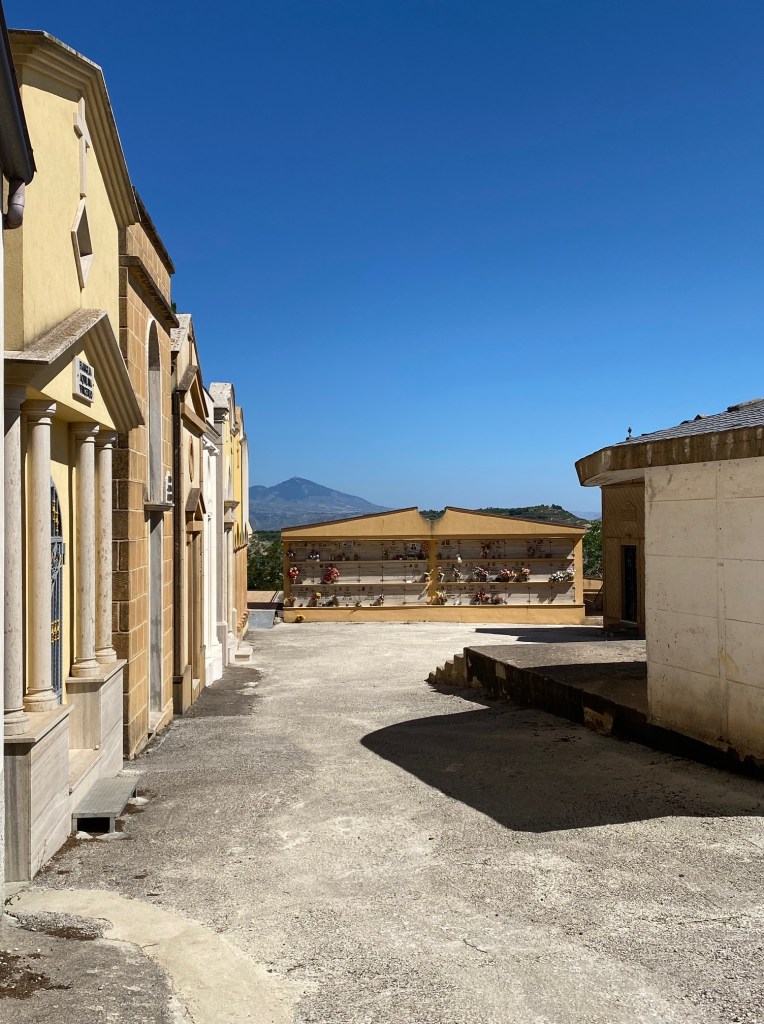
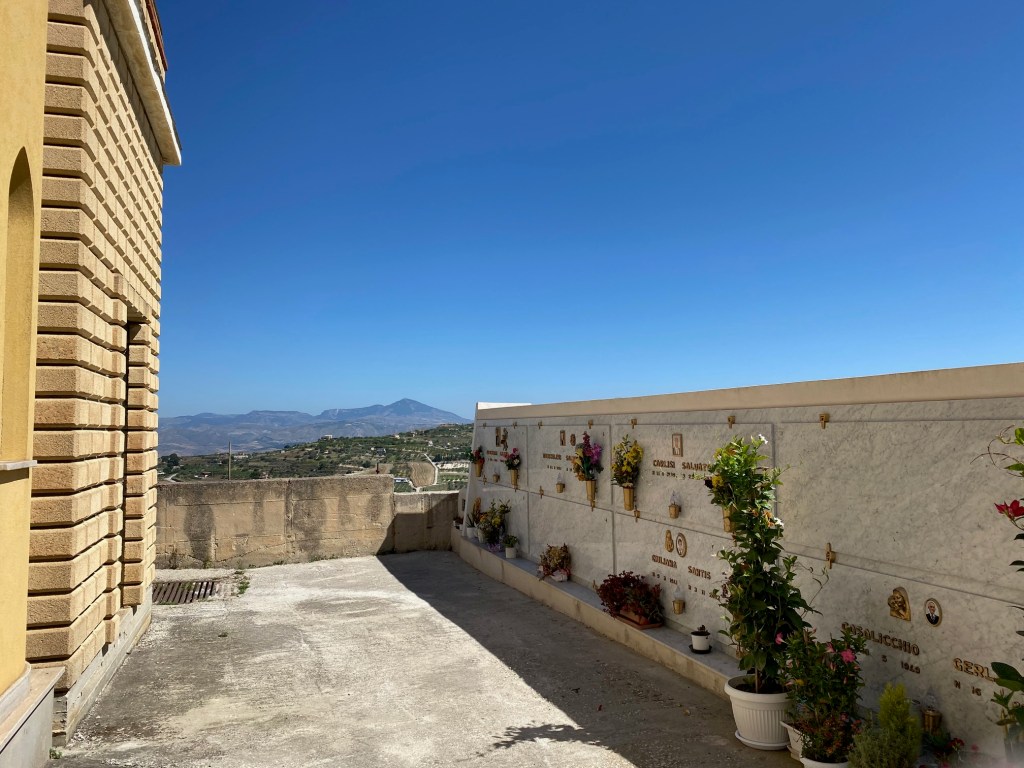
I was overwhelmed, in such wonderful ways.
The caretaker of the cemetery, an elegant and kind woman, spoke to me enthusiastically in Italian (thanks again, Google Translate!), trying to help ensure we could find what we were looking for. She seemed so deeply happy that we were there and trying to trace my roots, like I was being welcomed home by a stranger to a place I’d never been. She sent me off with a hug and a kiss.


I left the tie clip outside a Dimino family mausoleum, not sure (yet) if those Diminos are related but feeling like it appropriately honored the name’s presence in the area and the commemoration of those who have left us.
Again, I wrote a note to accompany these trinkets:
My grandfather – my father’s father – Alphonse Dimino, was a child of two American immigrants from Grotte, Francesco and Carmella (Valenti) Dimino. Al was a powerful presence, handsome and charming, a talented musician, and a loving family man, who died far too young.
On this first trip of mine to Sicily, I am honored to leave a little piece of him here in our homeland.
#GrandpaInGrotte

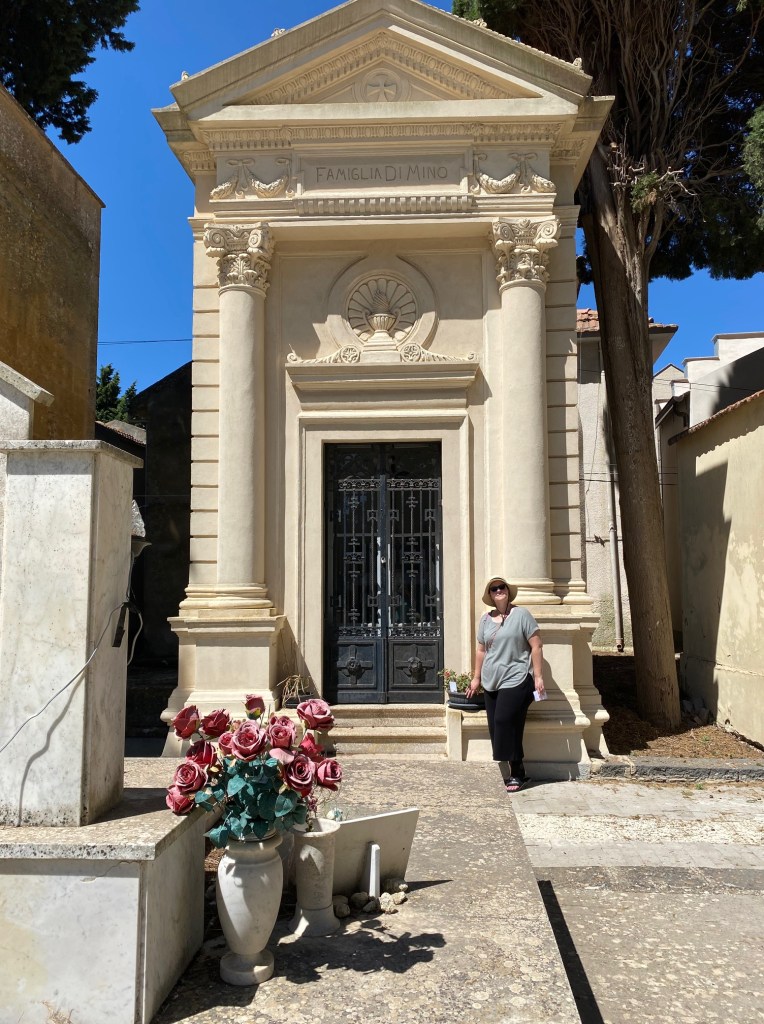

We ventured on into the town, sipping cappuccinos at a corner café, watching the old men sitting around chatting and the women bustling around with canvas bags on their shoulders. The man who had pointed us to that first Valenti headstone in the cemetery drove by and waved. Again, I felt so welcomed, so understood.
I wasn’t sure yet where I wanted to leave my grandpa’s cuff links. I felt a bit of pressure building as I wondered how I’d know what spot in this little area would be the right one.
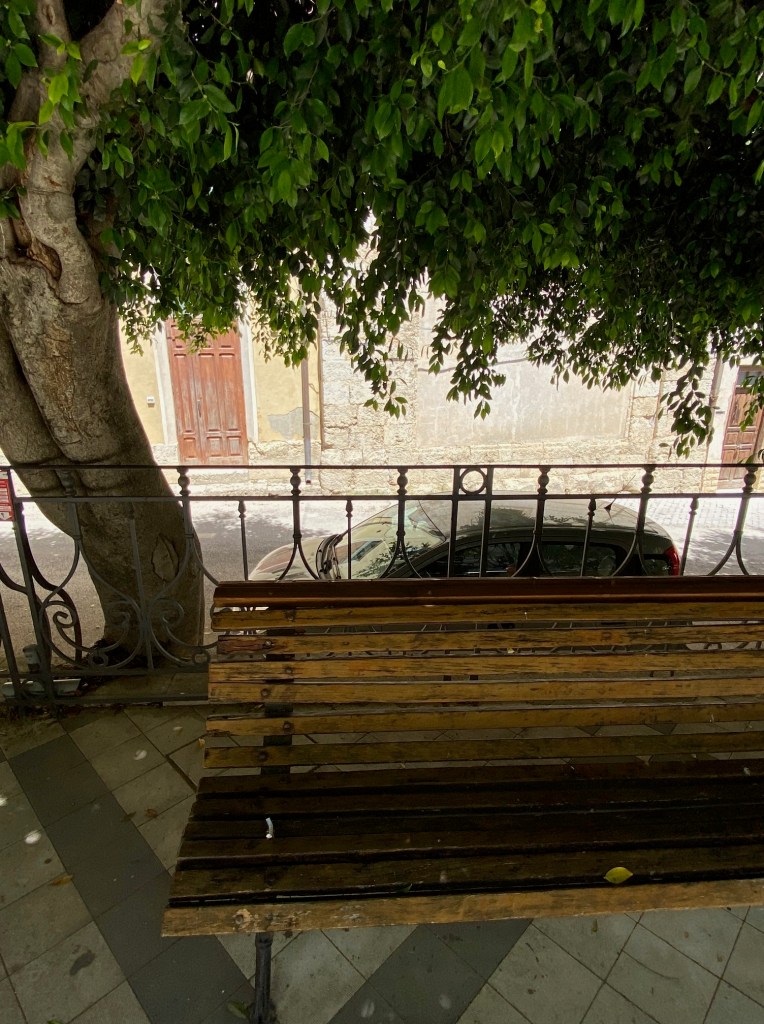
We strolled just a bit further, instinctively seeking some shade from a row of trees along a park-like stretch of sidewalk, lined with benches. And that’s when it felt precisely right.
Much like my visions of Aunt Penny enjoying the views from the benches of Paris, I imagined Grandpa Al sitting there on one of those Grotte benches, enjoying the shade and the breeze rustling through the trees. I looked out at the view he’d be seeing, of an inlaid stone street and buildings that had been there for centuries, and thought, This is the place.
Maria helped me roll the note up tightly so that we could slide it through the cuff links, hoping to ensure they wouldn’t get separated before someone found them. As I laid them down onto the bench, church bells rang out across the square. I was flooded with emotion, especially gratitude, in what felt like a cosmic moment between my grandfather and me.


My grandfather died when both he and his family rightfully assumed they had a lot of time left together. Aunt Penny died during the height of the COVID-19 pandemic, when so many gatherings were postponed with the thought that we’d make up for the lost time soon.
Tomorrow isn’t promised. Book the flight. Take the trip. And then, even when your feet are tired or the weather doesn’t cooperate or you’re hangry, savor every moment of it.
I’ll be forever grateful that I did.


 Valerie Dimino